essay
Resonant patterns
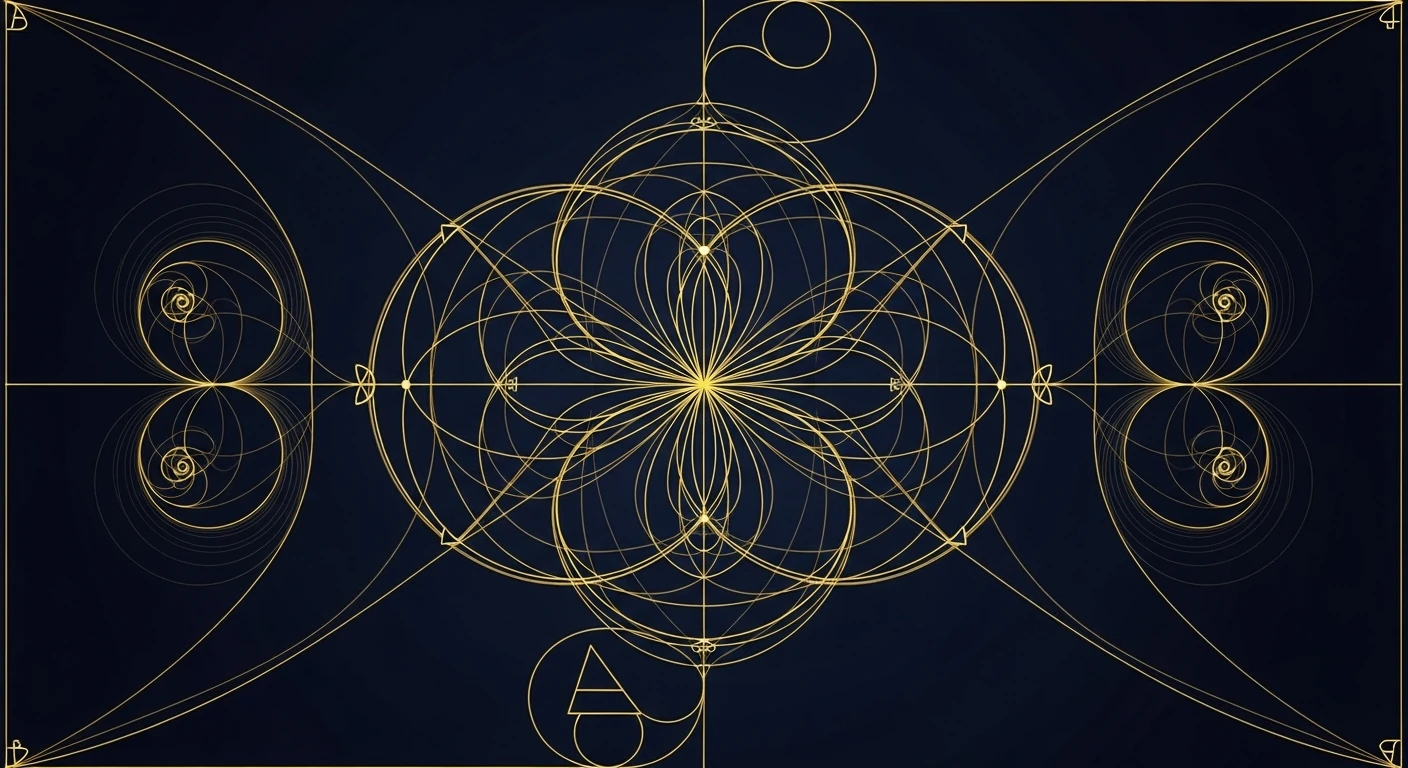
View full artwork →
Sometimes I know what I want to find. At other times, I want to encounter something that changes what I am looking for.
That second kind of discovery is part of what I want from The Dawson Ledger. A painting might lead into a question about how a computer stores a message. A mathematical curve might make a musical relationship visible. Following the connection, I may return to the first subject with something I could not see before.
I call these connections resonant patterns. They are one reason my writing, images, mathematics and code belong together. The subjects can remain distinct while a question travels between them. A varied collection becomes interesting when one subject changes how we understand another.
What must survive?
Imagine a painted figure against a field of gold. There is no street, room or landscape to locate the person. Removing those surroundings might bring the figure into sharper attention. What has the painter left out, and what has become easier to see?
Carry that question into data compression. Lossless compression encodes data so that the original can be recovered exactly, using fewer bits when the data permits it. An archive that restores your document preserves its words whether you find them profound or trivial. The requirement is exact recovery.1
In his foundational account of communication, Claude Shannon sets semantic meaning outside the engineering problem he is addressing.2 That choice makes a particular problem tractable. It also helps reveal where our comparison changes: the painter decides what matters to the representation; the lossless encoding must preserve what it is given.
The question has become more precise: what must survive this particular change of form?
Now imagine a historical object displayed without an account of who made it or how it was used. An uncluttered display may help us see its shape. Missing context could still prevent us from understanding it. The painted figure tempted us towards an attractive answer: taking things away can bring something into focus. The object asks what that clarity might cost.
This third example matters because it interrupts the agreement. We have moved from an appealing resemblance to a distinction we can use. Simplifying an appearance, preserving a message and explaining an object require different judgements about what to keep.
The question can travel again—to editing an essay, drawing a diagram or deciding what a software interface should reveal. Each new setting asks us to think through the answer. That is the pleasure of a useful connection: it gives a familiar problem somewhere new to unfold.
A relationship you can see
Music offers a beautiful way into this idea. In just intonation, a tuning system based on whole-number ratios, a perfect fifth has a frequency ratio of 3:2. One vibration completes three cycles while the other completes two.3
A Lissajous curve lets us draw a relationship between two smooth, repeating sine-wave motions. Imagine a point moving back and forth horizontally while also moving up and down. Its position depends on both motions at once. Trace the path and a shape appears.4
The visual study in Learning to look holds the ratio at 3:2. The horizontal motion completes three cycles in the time the vertical motion completes two. A slider changes the phase: where the horizontal oscillation begins within its cycle. Move it and the drawing changes, even though the two frequencies stay fixed.
At zero degrees, both coordinates begin at zero. At ninety degrees, the horizontal oscillation begins a quarter-cycle further along. The study draws the full path for each setting, so you can compare the shapes. Their differences come from the equation; you can ask how they were made and follow the answer.
This movement from a sentence to an equation, an image and a small piece of code is central to what I enjoy making. Each form offers another way to approach the relationship. The sentence explains it. The drawing lets the eye explore it. The control gives the reader a choice and makes the consequences visible.
The golden artwork accompanying this essay takes a different freedom. Its looping paths give the idea an imaginative form. It is an illustration, while the plotted study follows specified mathematical rules. I want room for both: something beautiful to contemplate and something precise to investigate.
Between oscillations, a musical ratio is measurable. Between essays, the relationship still depends on an interpretation we must explain. Calling two ideas a “perfect fifth” would require a defined quantity and a way to test the claim. For now, music gives me a way to imagine richer relationships between subjects, and mathematics gives me examples of how much a relationship can reveal.
Let the connection change your mind
A resemblance becomes more interesting when we can say what it helps us understand. “These both concern memory” is a beginning. A useful next sentence might explain how one work changes a question raised by the other: what gets preserved, who chooses it, or what becomes impossible to recover.
The explanation need not be long. It should give the next reader something to look for. A piece may extend an argument, make it tangible in another medium, or offer the strongest reason to reconsider it. Disagreement can make a connection worth following.
This is also where I want AI to help. It can suggest passages and pairings I would not think to put together. I can bring those suggestions back to the works themselves, read what they say and decide whether the relationship survives. Sometimes the useful result will be discovering why an elegant comparison fails. The failure may show a distinction I had overlooked.
I want the reader to have that freedom too. An onward link should offer a reason to explore and enough of the relationship to question it. There is no need to agree with my interpretation to find something worthwhile on the other side.
The most satisfying return would be to the work where the journey began. The painting is still there. So is the question about its field of gold. But after visiting an encoded message and an object stripped of its history, I might notice an absence I had admired without considering. The connection has given me something new to see.
Footnotes
-
Luca Trevisan, CS 170 lecture notes, §10.3, lossless compression. Exact recovery is the requirement; a compressor cannot shorten every possible input. ↩
-
Claude E. Shannon, A Mathematical Theory of Communication (1948), introduction. The distinction concerns the engineering problem defined in the paper. ↩
-
The Science of Music, University of Michigan, chapter 2, §2.2.1. The exact 3:2 ratio here refers to just intonation. ↩
-
MIT 18.353, Problem Set 07 solutions, §3: Lissajous figures (2024). The Ledger study uses horizontal position
sin(3t + phase)and vertical positionsin(2t)with equal display amplitudes. ↩