essay
The Dawson Legacy: From Loyalist Sergeant to Modern Stewardship
View full artwork →
From Loyalist sergeant to modern steward—tracing the ancestral lines and genealogical heritage of the Dawson family. Anchored by land patents, parish registers, and Masonic bonds across generations.
The Founding Covenant
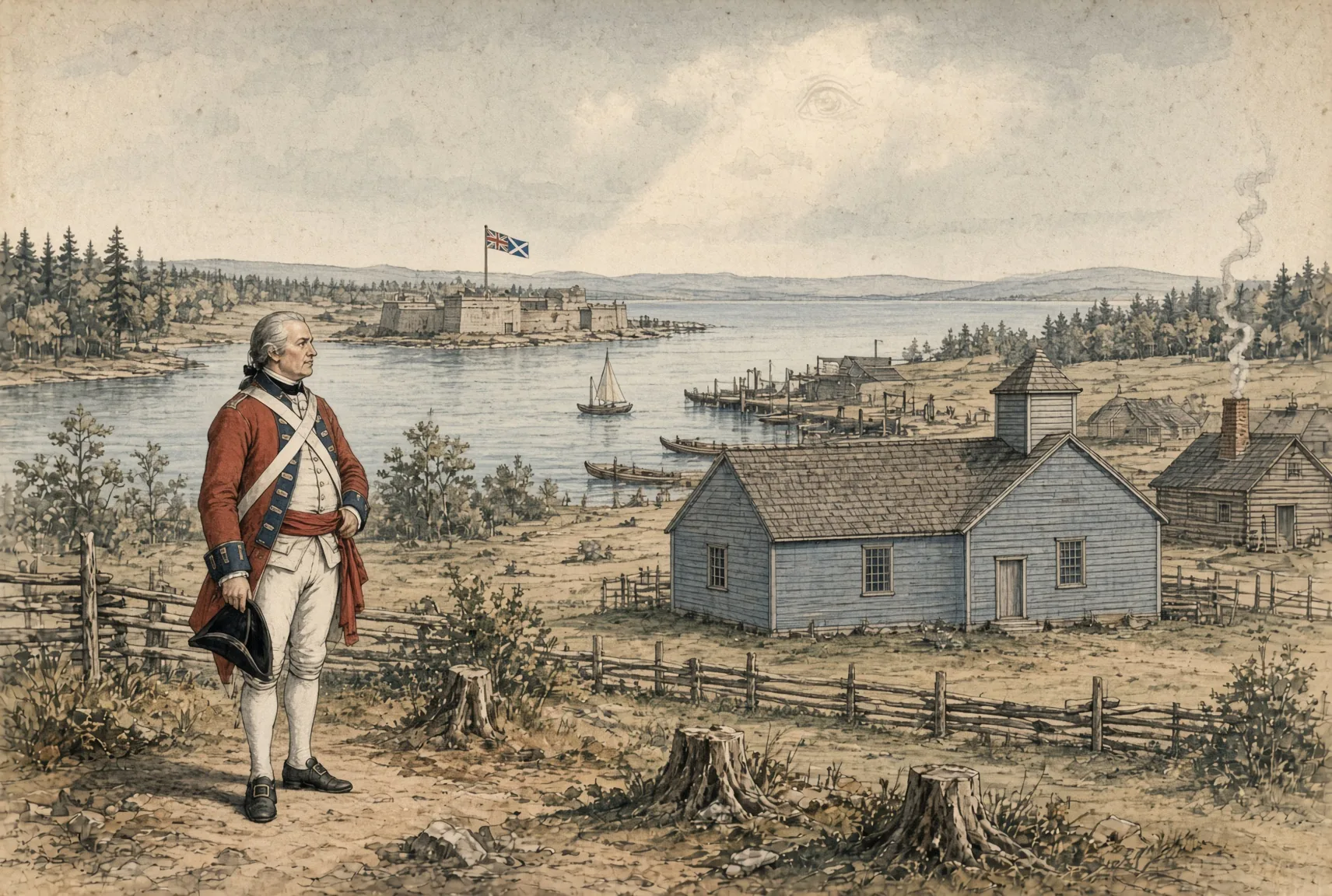
Loyalist sergeant James Dawson anchored our line in Canada with a Crown patent to Kingston Town Lot 123 in November 1807, after civic service as a Kingston constable (1797–98) and worship at St. George’s. From that legal foothold, Dawsons worked the St. Lawrence–Rideau–Great Lakes corridor, farming and trading into Kent County and Chatham, where the wheat sheaf becomes lived memory, not ornament.
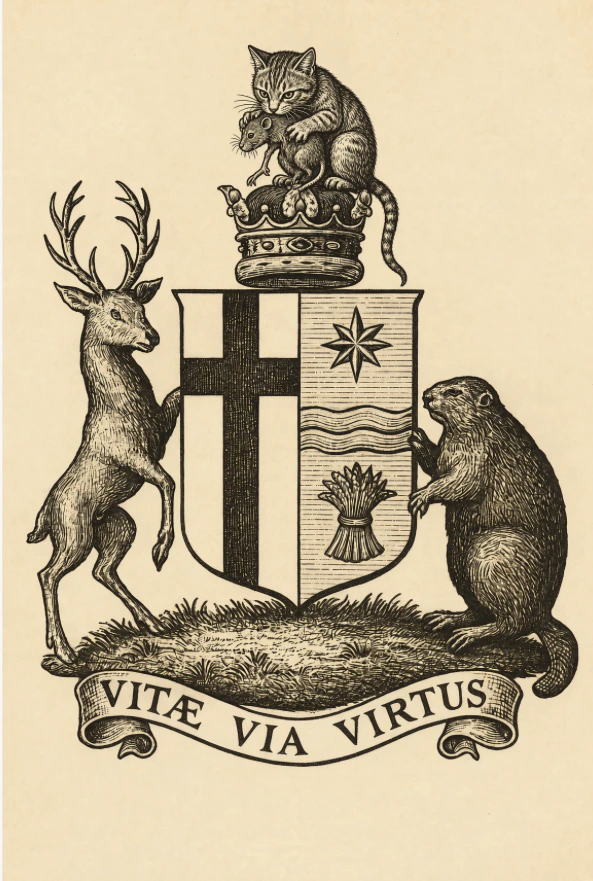
Our house symbol—a cat with a rat upon a crown—signals vigilant guardianship: calm until provoked, then lethal. The rat represents vermin, corruption, and treachery vanquished. We hunt what preys on the commons. Quiet strength, decisive action. Our operating rule is simple: VITÆ VIA VIRTUS — virtue is the way of life.
Family History
1790s–1810s: Kingston Beginnings
Loyalist sergeant James Dawson entered Kingston’s tight-knit Loyalist circle early: Freemason by 1795, constable 1797–1798, then securing Town Lot 123 beside St. George’s parish in 1807. In that compact world, families clustered around parish, lodge, and court—baptism sponsors, marriage witnesses, and memorial signers drawn from the same handful of households.
Kin by blood or by oath, this network provided practical safety nets for work, credit, and reputation. Parish rites built trust; Masonic bonds and civic service embedded us in Loyalist self-help structures. From James Dawson, the founding Loyalist Patriarch, through the generations to Michael William Joseph Dawson, the Masonic thread has woven through the Dawson line—sometimes active, sometimes silent, but never severed in heritage. The thread lapsed for a generation, but the ethic it encoded—duty, competence, integrity—was carried forward by William George through daily example rather than ritual form, until Michael William restored the formal Craft connection in 2022. Not ornament, but operating code.
1810s–1850s: Land & Kinship Network
We didn’t just acquire land; we designed a system. The 1807 Crown patent on Kingston Lot 123 anchored us in the city’s civic core. The 1823 split enabled a merchant overlay, and by 1825 the Gildersleeves were building on Parts 123 & 138, tying our ground to Kingston’s steamship era.
William Dawson’s Wolfe Island holding entered the story by right of a Loyalist-children grant—land set aside for sons and daughters of Loyalists—rooting our line at what became Dawson’s Point with shoreline, ferry channels, and arable acreage. Town legitimized us, trade compounded us, farmland sustained us. That’s the Dawson pattern.
Mid-1800s–Today: The Water & the Work
Movement along river corridors turned patents into livelihoods—farming, milling, waterways trade—driving the line toward Kent County and Chatham where the soil was rich and the harvest real. Grandfather James Glen was born in 1919 and grew up inside the Great Depression—a boy watching farms fail across Ontario, neighbours losing holdings that had been in families for generations. That experience forged him. He carried Depression-era discipline through the postwar decades and into decades of steady stewardship of the Kent County farmland. He held the land, held the ethic, and held the economic moat of the family intact. Freemason in the postwar era, when the Craft was thriving. Hands in the earth, grain to wharf, cashflow as lived reality through seasons and risk. Without his endurance, everything that followed would have had nothing to stand on.
Father William George is the transformation figure—the generation that carried the Dawson ethic from fields to professional life. That transition is where most family lines lose their coherence: the skills change, the context changes, the daily rhythms change. What survived the crossing was the ethic underneath. Through hard times of his own, William George maintained the commitment to duty, competence, and honest work, passing it forward through the most demanding mechanism there is: daily example. He did not become a Freemason—but he is alive, and the door remains open. What he preserved was arguably more fundamental than any institutional membership: the moral substrate without which the Craft’s rituals would be empty form.
Michael William carries the line forward as steward of the dossier and living inheritance—building systems where data flows replace grain flows but the pattern holds: anchor in community, partner with enterprise, own the inputs. The work turns verified institutional data into graph-shaped operating knowledge so stewardship can be traced, questioned, and audited.
The engines changed—millstone to balance sheet to compute—but the work didn’t. Farm taught the cycles; the Depression tested the endurance; the professional transition proved the ethic portable; the present era operationalizes at scale through systems and probabilities. Same river, new oars. Same creed: guard the store, reward real work, starve the rats. Continuity, not nostalgia.
House Lore
What we tell ourselves because it keeps us honest
The Cat’s Justice
Guardian of the commons: watchful in quiet, resolute when provoked. The cat seizes the rat—vermin, corruption, and treachery are met without indulgence. There is no tolerance for abuse. We pursue what preys upon others. Strength kept in reserve; action taken without clamor; judgment executed cleanly.
The River Bargain
The St. Lawrence, the Rideau, and the Great Lakes were arteries of commerce, not avenues of spectacle. If the waters carry a man to market, he returns with goods, intelligence, and benefit for the community. Trade is a duty to one’s neighbors, not an entertainment for oneself. No speculation, no treasure-seeking: flour to the mill, timber to the yard, word from the port. The river grants passage; the traveler renders service.
The Sheaf Rule
The wheat sheaf signifies Kent County—harvest made real, not emblem alone. Waste is theft from the morrow. Each bushel conserved becomes provision for lean years, capital for the next generation, and margin against calamity. Thrift is not miserliness; it is stewardship. The field taught it first: one does not consume the seed of the coming season.
The Cross and the Compass
Faith is foundation, not ornament. From James Dawson at St. George’s to Michael William’s return to the Anglican Communion, the Cross steadies our labor and gives it aim. Prayer on Sunday prepares the hands for Monday: to serve God is to serve His creation—the commons, one’s kin, and one’s craft. The Compass instructs the measure of conduct; the Cross declares its purpose.
Kin by Oath
Blood has its claim; oath binds more tightly still. In Kingston’s Loyalist circle, parish and lodge wove the net of aid—work, credit, and reputation held in common. Defend your kindred; honor your Brethren; keep faith with both. The bond is mutual: when one prospers, many are strengthened; when one falters, many uphold. Loyalty is chosen, and then kept.
The Eight House Virtues
The eight star points of our compass
- Truth — See clearly; speak plainly
- Justice — Balance the scales; right the wrongs
- Stewardship — Guard what is entrusted; compound it forward
- Courage — Stand when standing costs
- Prudence — Think before acting; measure twice
- Industry — Work is worship; idleness is theft
- Faith — Anchor in the eternal; serve the temporal
- Family & Fraternity — Blood and oath together
The Genealogical Line
Confirmed by land instruments, St. George’s registers, and paternal Y-DNA triangulation
-
James Dawson (1738–?) — Loyalist sergeant; Kingston constable 1797–98; Crown patent: Town Lot 123 (Nov 1807); St. George’s parish
-
William Dawson (1794–1869) — Son of James; establishes 19th-century continuity in the region
-
John Dawson (1820–1897) — Links Kingston/Kent networks; documented in mid-century records
-
William Edwin Dawson (1845–1877) — Transitional generation into late-Victorian period
-
John Samuel Dawson (1873–1956) — Early 20th-century household head; parish and civic paper trail
-
James Glen Dawson (1919–1994) — Grandfather; Freemason (postwar era); Depression-forged discipline sustained the family’s economic moat and ethical foundation; civic records
-
William George Dawson (living) — Father; transformation figure who carried the Dawson ethic from agricultural to professional life; daily example of duty and competence through hard times
-
Michael William Joseph Dawson (present) — Present bearer; custodian of the dossier and armorial; initiated into the Craft 2022
-
James Michael William Dawson (2026) — Future custodian of the family name
Key Themes
These patterns—Service → Trust → Scale, Asset Patience, Proximity to the Commons—aren’t accidents. They’re structural forms that recur across generations.
What’s Common Across Generations
Service → Trust → Scale — Take on public work; earn reputation; unlock the next opportunity. From constable to lodge member to steamship-adjacent landholder to modern steward, the pattern repeats: demonstrate competence in civic or commercial duty, build networks of trust, then leverage that standing to expand the scope of stewardship. Reputation compounds across generations.
Asset Patience — Land and institutions held—or seeded for others—over long horizons. Town Lot 123 was not flipped; it anchored. Wolfe Island acreage became Dawson’s Point. Freemasonry was restored after a generation’s silence. The estate and trust are designed to fund virtue and civic work for centuries. We do not extract and exit; we compound and transmit.
Proximity to the Commons — Churches, lodges, councils, ferries, wharves—Dawsons show up where community life is organized. St. George’s parish, Masonic lodges, constable duty, steamship trade corridors, balance sheets that govern pension capital. We anchor near the institutions that coordinate trust, movement, and provision.
Intergenerational Hand-off — Knowledge, networks, and capital reliably passed forward. From James’s constable service and lodge standing to William George’s ethics, capital and knowledge, to Michael William’s design for multi-generational wealth and civic duty, each generation receives tools and obligations.
What’s Exceptional
A Grant That Became a Landmark — Few families can point to a Loyalist-era lot that remains a high-value heritage property with a published market signal—and a full public history linking the original grantee by name. Town Lot 123 is not folklore; it is documented, mapped, and monetized continuity.
A Name in the Water — Living toponymy—Dawson’s Point—is rare. Most families fade from the map. Ours is etched into daily commerce and navigation on Wolfe Island, a daily reminder of practical importance to movement, ferry routes, and shoreline coordination.
From Constable to Modern Stewardship — The modern Dawson story extends the ethic of custodianship from roads and docks to balance sheets, risk systems, and intelligence platforms. James kept order in Kingston’s streets; the current generation builds systems meant to make stewardship traceable and auditable. The domain shifted from physical commons to financial and informational infrastructure, but the duty remains: guard what belongs to others, starve the parasites, reward the faithful.
Restoration & Transmission
Michael William Joseph Dawson carries the restoration forward—not as memory, but as mission. Initiated into the Craft in 2022, he brought Freemasonry back to the Dawson line after a period of silence, restoring continuity with his Loyalist Patriarch James Dawson. He returned to the Anglican Communion—the faith of St. George’s parish where James worshipped—closing a circle broken by time. This essay does not claim a present lodge office.
The dossier itself—land chain verified, church registers traced, Y-DNA confirmed, an armorial design taking shape—is an act of deliberate architecture: turning scattered fragments into accountable lineage.
But restoration is more than genealogy. It includes building generational infrastructure: compounding capital toward a family estate and trust, designed to fund education, civic works, and institutions rooted in classical values. The creed is simple: bring back what worked, starve what destroys, and transmit virtue as deliberately as wealth.
The story is told forward as a standard for conduct, an operating system for permanence. Tradition is not nostalgia. It is continuity chosen, fought for, and built to last.