essay
Synthesis: The Self-Describing Cathedral
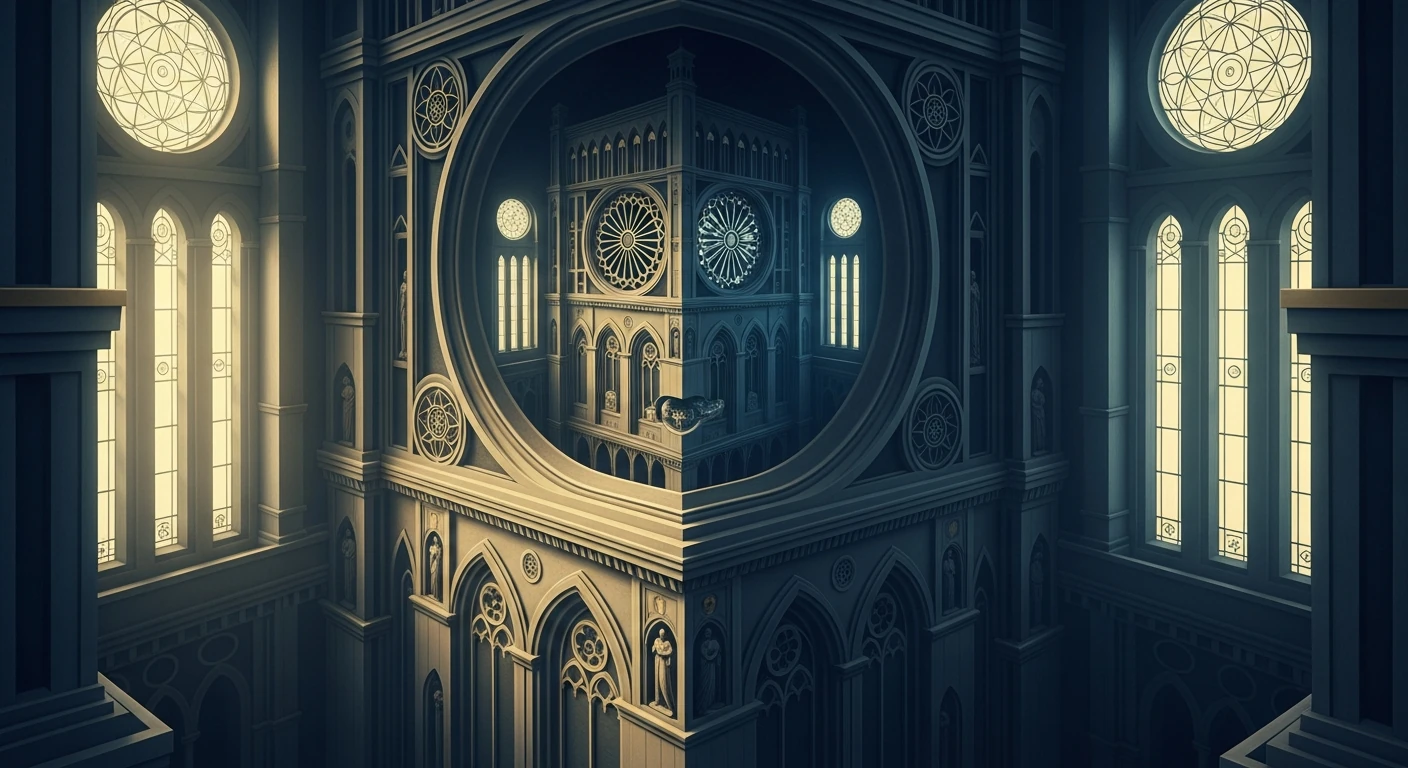
View full artwork →
The Ledger began with a conviction: VERITAS ARCHITECTURA EST—truth is architecture. I wanted what I believed, wrote and built to belong together. The cathedral gave that ambition a form: a place made carefully, with room for beauty, learning and something that might outlast its maker.
The building then became a subject of its own. The Architect’s Workshop described its principles, the conversations with AI and the discoveries made along the way. Writing about the building made its workings available to another mind: the convictions behind a decision, the technique that gave it form, and the possibilities it opened.
The architecture of an experiment
The early Ledger gave interdisciplinary curiosity a formal home. Its Pattern Graph organised ideas into families. A triadic taxonomy—a three-part classification—distinguished approaches to them. The Resonance Engine suggested connections using chosen criteria and musical labels. Journeys arranged essays into sequences; colour and proportion carried symbolic meaning.
The original project also explored Docent as a guide and Mirror as a view of the collection and reading activity. These are historical experiments, rather than services a reader should expect to find running here.
The desire remains. A distant subject can illuminate an essay; a picture can make a relationship visible; a sequence lets an argument grow without repeating the whole philosophy on every page.
The Ledger is my blog and idea space: writing, art, code, music and family stories, with reasons to move between them. Each work should reward attention on its own. A connection offers another way into it.
Follow one thought into another form
An essay on resonance asks whether ideas from different fields can illuminate each other through a shared pattern. The musical association also invites a visual experiment.
On Connections, the small Lissajous drawing follows two equations:
One motion carries a point horizontally, the other vertically. Their rates have the ratio 3:2. The phase, , is their relative offset: changing it changes how the motions meet. Move the control and watch the same pair of rhythms draw a different figure. The separate Parametric Harmony study explores a 5:4 composition.
Here an essay leads to mathematics, an image and the code that draws it. The equation specifies a relationship precisely; the picture makes it visible. The larger connection between ideas still needs explanation. A beautiful curve can make that question vivid without proving that two essays share a mathematically measurable affinity.
What a system can explain about itself
The original Ledger made parts of its organising method explicit enough for software to inspect. A program could check categories and references against the stated rules. This made the arrangement easier to extend and gave another builder a way to understand how its pieces fitted together.
The rules describe how the collection is arranged, rather than establish philosophical truth. Sacred geometry gives a personal conviction about truth, order and beauty a visible expression; the writing develops the argument behind it.
Self-description adds a second way into the work. A reader can enjoy a finished image; a builder can follow the reasoning that shaped it and try a variation. The blueprint becomes part of what the work offers.
Building with AI, learning through revision
AI helped develop the prose and software and imagine forms they could take. Writing an explanation sharpened a design; seeing a working page suggested a connection or variation that the explanation had not anticipated.
That movement is the lasting pattern: give an intention a form, encounter the result and let the experience develop the idea. Retaining the original beside a later account makes the path visible, from the first intuition to what it became. Someone else can enter that process and take it in a direction of their own.
Experiments worth carrying on
I want to continue exploring harmonic resonance through things someone can try. A proposed public code companion could offer small examples with visible results.
A curve generator could let someone change ratio and phase, then save an image with the settings needed to reproduce it. A connection explorer could explain why two works were linked and leave them unconnected when no meaningful relationship is found. An art-direction example could show how a chosen pattern informs colour or composition, allowing someone to alter the rule and compare results.
These possible next experiments draw on ingredients in the original code. The mathematical example can test a calculation; the editorial and artistic examples invite judgement. I want those differences to be tangible, with room for discoveries I cannot specify in advance.
Carrying the workshop forward
The five essays follow a sequence. Philosophy asks what the work is for. The six techniques carry intention between conversations. Economics considers possibility and continuing care. Liturgy asks how practice shapes the person using the tools. This final essay returns those questions to the thing being made.
The Christian purpose remains: to use my abilities with care, in service to God and to others. The cathedral encourages patience, beauty and responsibility for what I leave behind. That purpose can find expression in an essay, a drawing or a small piece of code someone can use.
A reader might arrive for an essay, a family story or a drawing. I hope a connection opens something unexpected. If the work explains enough of its making for someone else to carry it further, the workshop has something worth passing on.