essay
The Pyramid as Resonance Chamber
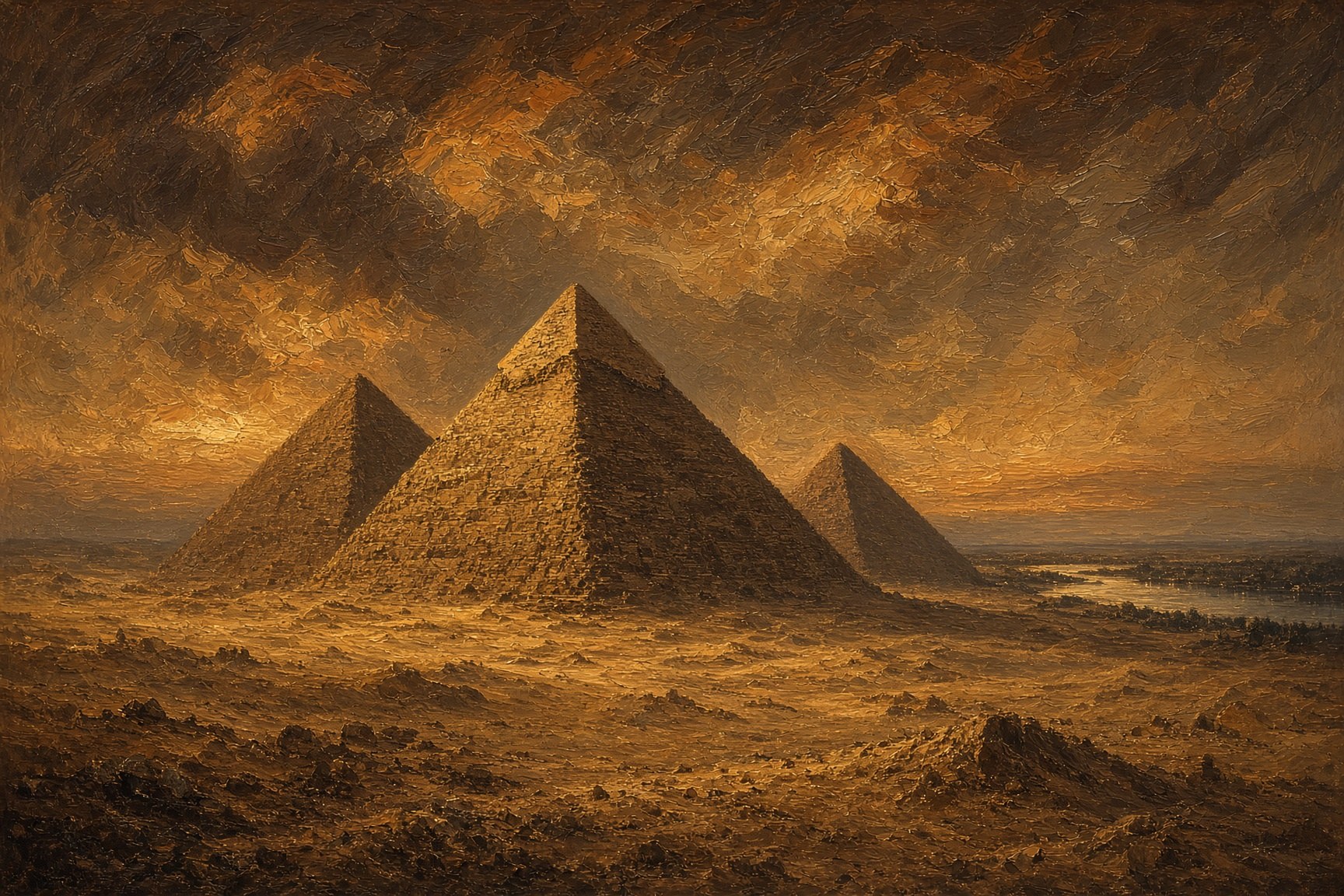
View full artwork →
A room can hold a note after the singer has stopped. A building can outlast the language of the people who raised it. Between those two forms of survival lies the question that draws me back to the pyramids: how much can a structure preserve after its explanation has been lost?
I am interested in the stone, but also in the inheritance. What did the builders learn through practice? Which effects did they seek, and which did they discover along the way? Could a technique have passed through generations that understood it differently?
My suspicion is that the human past contains more continuity, disruption and forgotten capability than our familiar summaries convey. The pyramids give that suspicion a place to become a question we can examine. Their actual history matters enough to resist making every discovery tell the same story.
The physical findings are one part of what interests me. I also want to explore a more speculative possibility: that some encounters we describe as arrivals might belong to an interrupted human inheritance. The pyramids do not establish that account. They are one place where my question about what survives begins.
A structure with more than one life
The discovery that first caught my attention was a 2018 electromagnetic study. Mikhail Balezin and his colleagues used numerical simulations to investigate how a simplified Great Pyramid would interact with radio waves between 200 and 600 metres in wavelength. Under the modelled conditions, energy could concentrate in particular interior regions and beneath its base.1
This was a theoretical result about an illuminated structure. It was not a measurement of a running ancient machine. Its attraction, for me, is the possibility that a familiar shape has physical behaviours we have barely considered when looking at it as a monument.
There is a useful distinction here. A structure may resonate; its builders may have noticed some form of resonance; they may have deliberately used it. These are three different claims. Establishing the first gives us a reason to investigate the others, rather than permission to assume them.
Sound offers a more immediate way into the question. The Pyramid Tracks project, presented at EVA London in July 2026, describes impulse-response recordings from the King’s, Queen’s and Subterranean chambers, used to let musicians place new compositions within simulations of those acoustic spaces.2 The project gives us a way to listen to an architectural difference. It does not, by itself, recover an ancient ceremony or establish its purpose.
That connection feels especially close to my own interests. In music, the room becomes part of the sound. In architecture, a proportion becomes something the body encounters. An acoustic recording can preserve a small part of that encounter and make it available to someone who has never entered the chamber.
I would rather hear what the space does than settle too quickly on a sacred frequency said to explain it.
The discoveries inside the familiar outline
The Great Pyramid is still yielding previously unknown spaces. In 2017, the ScanPyramids collaboration reported a large void above the Grand Gallery, detected independently with three kinds of muon detector.3 In 2023, researchers characterised a separate corridor behind the north-face chevron, roughly nine metres long with a cross-section of about two metres by two metres.4
A 2025 study combined images reconstructed from ground-penetrating radar, ultrasound and electrical-resistivity measurements to investigate that north-face corridor.5 The appeal is the convergence: different instruments, with different limitations, examining the same place.
A void is not yet an explanation. It may relate to construction, weight, access, ritual, or a purpose the surviving evidence has not disclosed. Even so, an unknown space inside one of the world’s most examined buildings is a reminder that familiarity can be mistaken for completeness.
The discovery I find equally arresting is outside the stone. In 2024, researchers mapped remnants of the Ahramat branch of the Nile beside a chain of 31 pyramids. Radar imagery, geophysical work and sediment cores supported a picture of monuments linked to a waterway that has largely vanished from the modern landscape.6
We are looking at a surviving building in a changed world. Remove a river from the picture and a harbour becomes puzzling. Remove the people who maintained a technique and its result becomes mysterious. Before asking what extraordinary civilisation a monument requires, we should try to restore the ordinary world that made it possible.
“Ordinary” here can include astonishing skill.
Water, machines and competing explanations
Recent engineering hypotheses make the picture more interesting. A 2024 paper proposed that hydraulic force may have assisted construction of Djoser’s Step Pyramid at Saqqara. The authors connect features of the surrounding landscape and internal shafts into a possible water-management and lifting system.7
It is a proposal about a different pyramid, not a demonstrated mechanism for Khufu’s. Its value as a line of enquiry is that it asks specific questions: where would water come from, how would it be controlled, and what physical traces would the proposed arrangement leave?
Christopher Dunn’s power-plant hypothesis makes a much larger claim. He interprets the Great Pyramid as an engineered system using resonance to transform energy, rather than solely as a funerary monument.8 I find the attempt to read chambers and passages as interacting components worth considering. A technical story still has to explain an energy source, conversion, output and use. A resonant property alone does not establish the complete machine.
The much-publicised claims about immense structures beneath Khafre require similar care. The journal Remote Sensing retracted Biondi and Malanga’s 2022 Great Pyramid radar-tomography paper in August 2026, citing methodological and statistical problems; the authors disagreed.9 That paper concerned Khufu and was not the later Khafre announcement. Its retraction nevertheless prevents me from treating the published method as settled support for the underground claims.
I want unusual proposals to be examined well enough that a surprising result can survive criticism. That means asking proponents for evidence another team can test, and asking critics to address the actual claim. Neither enthusiasm nor institutional standing is a substitute for the work.
Builders, inheritors and a deeper human past
There is direct evidence of Egyptian work on Khufu’s pyramid. The journals of Merer record a crew transporting limestone from Tura to the construction site. The excavation team’s account places those records within a wider network of boats, supplies and labour.10
That human world should remain visible. It is too easy for a mystery narrative to erase the very people whose accomplishment first inspired the question.
It also leaves room for a different kind of inheritance. A builder can receive a proportion, a method or a ceremonial practice without receiving every reason that originally accompanied it. A craft can persist through changes in language, belief and political order. Those possibilities do not require us to deny Egyptian construction. They invite us to ask what its builders inherited, changed and contributed.
From ancient craft to a personal hypothesis
This is where the pyramids connect, for me, to the older-humanity hypothesis I explore elsewhere. Suppose some experiences described as contact involve something tied to humanity’s own past. The questions would then include memory and kinship: what had been preserved, what had been concealed or lost, and why contact would take the form it does.
The pyramids do not establish that premise. Lost techniques do not establish a surviving hidden population, and an acoustic effect tells us nothing about an entity’s intentions. The connection is a speculative framework in which to ask new questions, not a chain of proofs.
What draws me to it is the possibility that the unfamiliar might be an estranged part of our own story. An encounter interpreted as arrival could, within that hypothesis, be a return. A claimed gift of knowledge could be an inheritance—or an attempt to acquire authority over people who no longer remember its source.
That last possibility brings me back to discernment. Power and antiquity would not establish goodness. My Christian concern with the intentions behind an apparent revelation remains relevant even if my preferred account of its origin proves wrong.
What can survive a broken history?
A vanished river offers a concrete example of how much context can disappear. It does not demonstrate a single global flood or a common catastrophe behind every tradition. It does make me reluctant to assume that a landscape, or the memory of living in it, has always resembled what we see now.
Stories of destruction and renewal might preserve particular experiences through later retelling. Some may converge because people faced similar conditions at different times. A broader cycle of change is a hypothesis to investigate through dated local evidence, rather than a chronology to impose on every story.
The same care can make connections richer. The pyramid opens into the study of water and shared life; the sounding chamber into music; the surviving technique into apprenticeship; the missing explanation into the question of what families and civilisations manage to pass on.
These are different relationships. Their interest lies in following each far enough to discover where it holds.
I keep returning to the room after the voice has stopped. The sound fades, but the room remains capable of answering another voice. Something has survived without preserving every performance that gave it meaning.
Perhaps some ancient works carry knowledge in that way: in a form waiting for someone to encounter it again. I suspect there is more to recover than we presently know. The next step is to listen carefully enough that the stones can surprise us.
Sources and further reading
Footnotes
-
Mikhail Balezin, Kseniia V. Baryshnikova, Polina Kapitanova and Andrey B. Evlyukhin, Electromagnetic properties of the Great Pyramid, Journal of Applied Physics 124, 034903 (2018). Numerical investigation; not an on-site measurement of ancient power generation. ↩
-
Carl Hayden Smith, Scott Beibin and Savej, Pyramid Tracks: Composing with the Archaeoacoustics of the Great Pyramid, EVA London 2026. Practice-led acoustic and musical project; the conference abstract describes its recordings and compositional use. ↩
-
Kunihiro Morishima and colleagues, Discovery of a big void in Khufu’s Pyramid by observation of cosmic-ray muons, Nature (2017); authors’ open manuscript. ↩
-
Sébastien Procureur and colleagues, Precise characterization of a corridor-shaped structure in Khufu’s Pyramid, Nature Communications 14, 1144 (2023). ↩
-
Confirmation of the ScanPyramids North Face Corridor … using multi-modal image fusion, Scientific Reports (2025). ↩
-
Eman Ghoneim and colleagues, The Egyptian pyramid chain was built along the now abandoned Ahramat Nile Branch, Communications Earth & Environment 5, 233 (2024). ↩
-
Xavier Landreau and colleagues, On the possible use of hydraulic force to assist with building the step pyramid of Saqqara, PLOS ONE (2024). Construction hypothesis for Djoser’s complex, not an established explanation for the Great Pyramid. ↩
-
Christopher Dunn, The Giza Power Plant (1998), publisher’s account of the author’s hypothesis; see also Dunn’s own follow-up account. These describe the proposal, not independent verification. ↩
-
Remote Sensing, retraction notice for Biondi and Malanga’s 2022 paper, 10 August 2026. Research status checked 2 October 2026. ↩
-
Pierre Tallet, The Logbook of Merer, English summary, in Les papyrus de la mer Rouge I (IFAO, 2017), p. 160; see also the excavation team’s Wadi el-Jarf account. ↩