essay
The city beyond the monument
View full artwork →
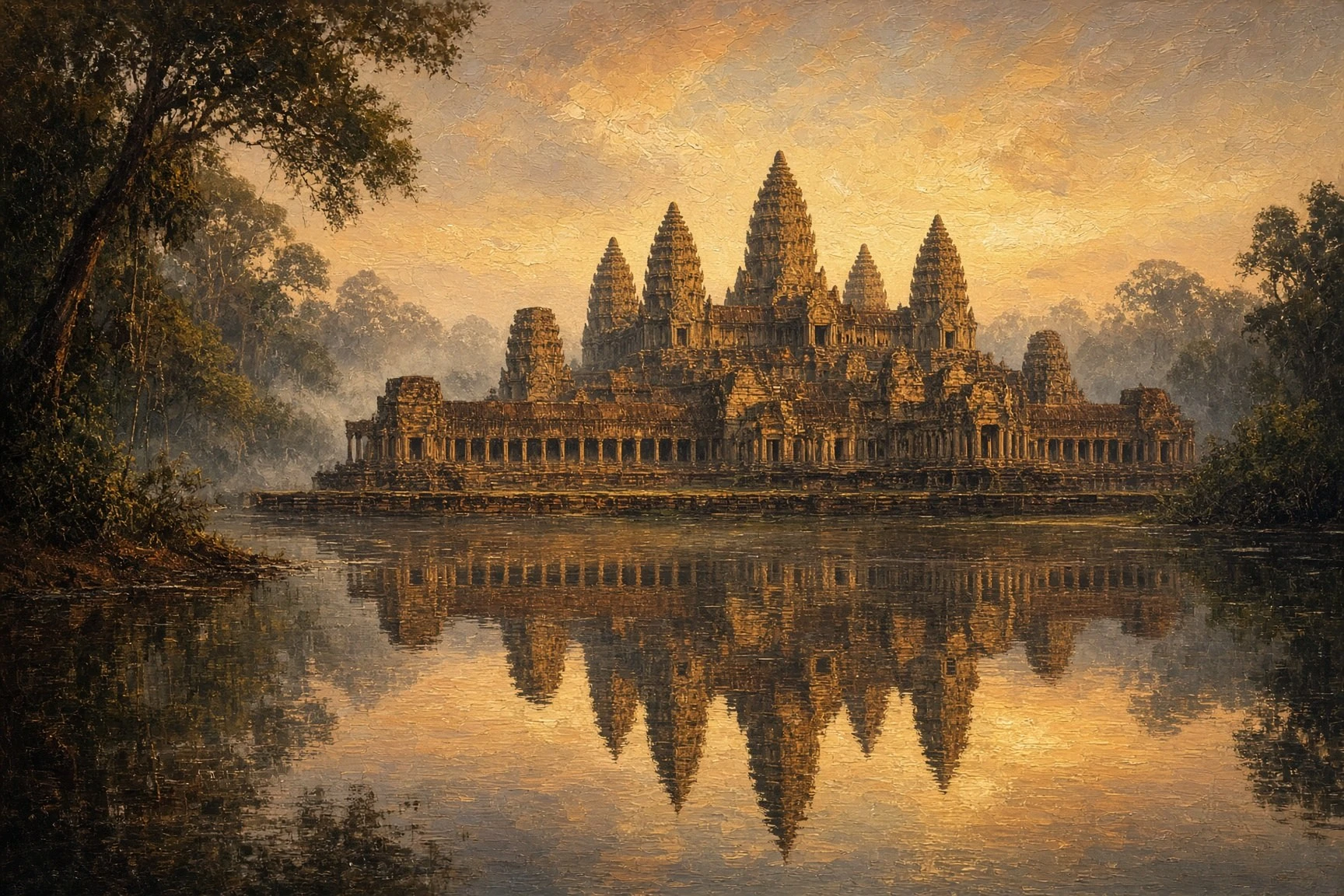
The towers of Angkor Wat rise twice in the painting: once from the earth, once from the water. Golden light catches the stone; trees gather at the edges. It is easy to let the whole city become this one beautiful view.
I find myself wanting to look beyond it. Who brought food to the people who built here? Where did the water go? What work had to happen again tomorrow?
Those questions change the scale of the picture. An account small enough to hold can connect people who never meet. A drain joins one household’s daily life to the street outside. A channel carries a decision across a landscape. Three surviving traces, from very different places, let us follow those connections beyond the monument.
An account small enough to hold
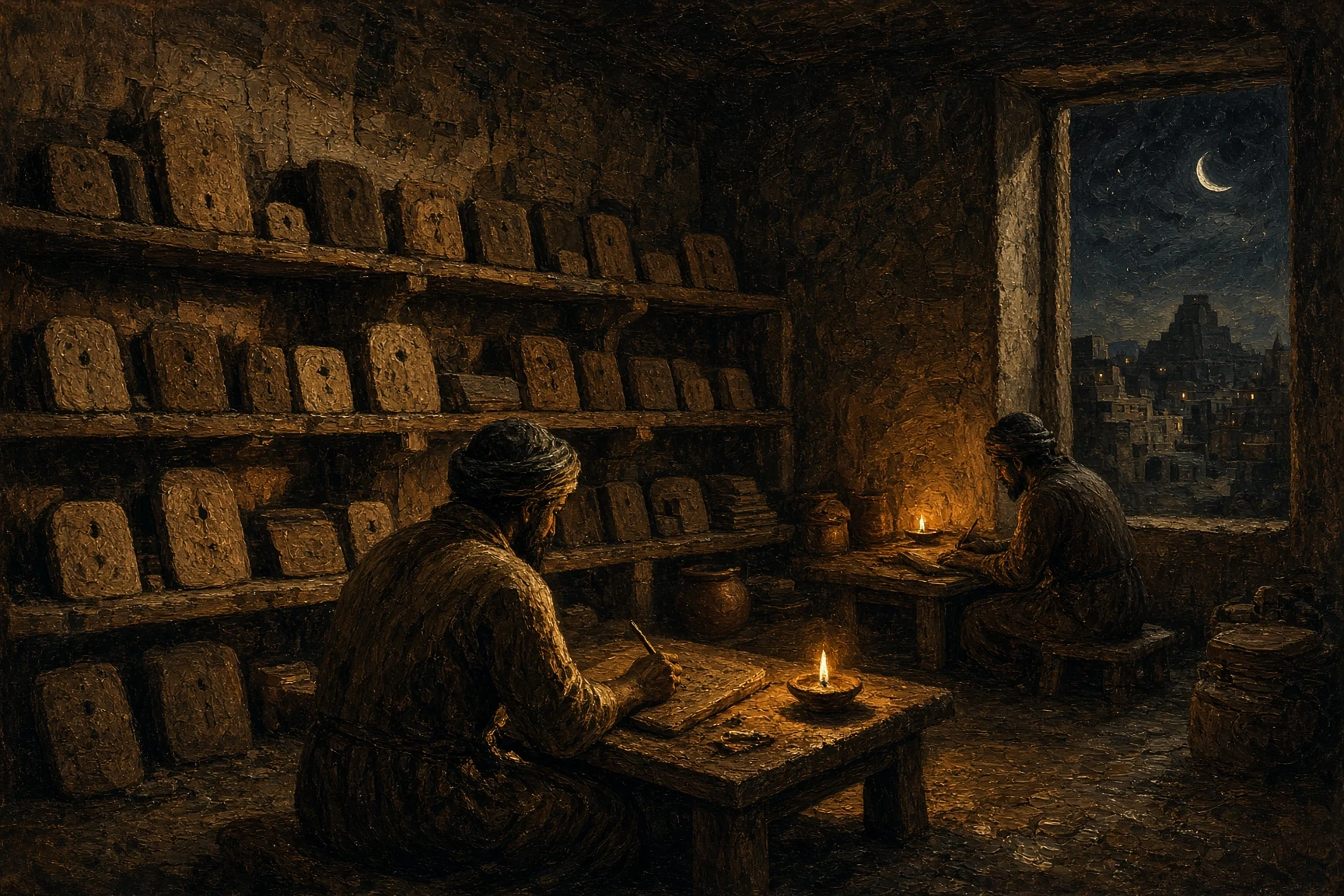
In the Metropolitan Museum is a clay tablet, probably from Uruk, dated to about 3100–2900 BCE. It is roughly six centimetres across. The marks most likely record grain distributed by a temple, although the catalogue cautions that the early writing is difficult to interpret with certainty.1
The smallness is part of its fascination. An arrangement between people has acquired a form that can survive them. We do not know their faces. We can still recognise the need to make an account.
A record allows a task to continue after the conversation ends. Someone else can consult it, question it or act on it. That makes writing a practical enlargement of memory: people no longer have to hold every obligation in one person’s head.
It also gives memory a shape. An account preserves what its makers chose to count. Grain appears; much of the life surrounding its distribution does not. We can admire the achievement while wondering whose work became visible through it, and whose remained outside the marks.
A household joined to a street
Mohenjo-daro, in the Indus valley, offers a different entrance. The remains of this third-millennium BCE city include wells, bathing spaces and an elaborate drainage system. In its lower town, streets meet at right angles.2
A drain invites less ceremony than a tower. Follow its course, though, and a private action enters a shared world. Water leaving one home must go somewhere. A blockage does not respect the boundary of the household that helped create it.
The surviving fabric makes interdependence tangible. It shows an accomplishment extending beyond an individual building, even where the people responsible for its daily care remain difficult to recover. The plan alone cannot tell us whether the arrangements were fair or how disputes were settled.
The tablet preserves a transaction after the people involved have gone. The drain makes a different relationship visible: neighbours remain entangled even when each is attending to a private task. Who would notice a blockage? Who could require a repair? The questions arise from the object itself, even where the surviving evidence cannot answer them.
Water outside the frame
At Angkor, look outward from the temple and the view widens into a worked landscape. UNESCO describes the Khmer capitals, spanning the ninth to fifteenth centuries, through their temples and roads as well as basins, dykes, reservoirs and canals.3
The reflected towers now belong to a larger question about water. At the scale of a landscape, neighbours need not live next door. A channel carries the consequences of decisions made elsewhere; maintenance in one place can matter to people who never see it. The eye follows the stone upward. Following the water asks us to look sideways, towards the lives around it.
I do not find that practical view diminishes the beauty. It gives the beauty neighbours. The monument becomes part of an inhabited world, where devotion, authority, skill and daily necessity met. Admiration can widen from the finished stone to the work that made a shared life possible around it.
These places are separated by geography and long stretches of time. Their resemblance here is a question brought to them: how did people make arrangements durable enough for others to depend on? Their answers need their own histories. A useful comparison makes those differences easier to see.
What we learn to notice
This is what draws me to the study of civilisation. A surviving object can interrupt the familiar procession of rulers and wars. These traces widen the circle of attention, from an exchange between people to a household among neighbours, then to a landscape of connected settlements. They make the city harder to mistake for its most famous building.
The connection reaches into ordinary life without making our circumstances identical. We still depend on work done beyond our sight, and on people keeping promises we did not personally arrange. Sometimes the most revealing question about a place is what its inhabitants have learned to take for granted.
The monument deserves our attention. So does the quiet work through which a city becomes somewhere to live.
Footnotes
-
The Metropolitan Museum of Art, administrative tablet, object 1988.433.1. The catalogue qualifies both its probable origin at Uruk and its interpretation as a grain account. ↩
-
UNESCO World Heritage Centre, Archaeological Ruins at Moenjodaro, “Brief synthesis.” ↩