essay
Cost has a flavour
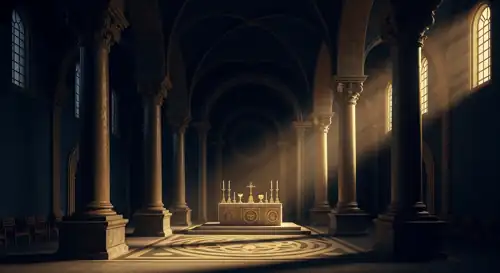
View full artwork →
My daughter was baptised in an Anglican parish. The choir is glorious, the friendships warm, the welcome real. It is a community my family loves.
I grew up inside Catholic walls: uniforms, nuns who meant what they said, priests who knew my name. I spent a period outside faith before finding my way back to Christian life. Fatherhood has brought that early formation into sharper focus. I find myself thinking about what I received before I understood it, and what I hope to pass on.
A calendar that gives the year a shape. Words and gestures worth learning carefully. Promises that survive a change of mood. These things make belief part of a life, with claims on our time, attention and comfort.
They help explain my enduring attraction to Catholic life, and why I prefer Catholic education for my daughter.
The care a form deserves
Masonry has given me another way to understand that attraction. I am drawn to the spirit of strict observance: ritual prepared carefully, performed with attention and treated with respect for the craft. Someone has taken the trouble to learn the words, understand the sequence and give each part its due.
You can feel what that care contributes. A pause is allowed to remain a pause. A familiar passage receives the attention it would deserve if someone were hearing it for the first time. The form has been entrusted to people who take responsibility for carrying it well.
That seriousness is compelling. It invites us to rise to the occasion.
I suspect a related hunger helps explain the renewed interest in Catholic and Orthodox worship reported in some communities.[1] There is an attraction in entering a form that asks us to learn its language and make room for its rhythms. We can participate before we can explain everything we are participating in. Understanding has somewhere to grow.
The appeal of the Mass has a further depth for me. In Catholic teaching, Christ is truly present in the Eucharist.[2] The gestures of reverence answer to that claim. Their purpose reaches beyond the atmosphere they create.
I want a form that refuses to be packaging.
Beauty can invite attention. What holds me is the conviction that there is something real to attend to, something whose meaning does not depend entirely on what I happen to feel that morning.
What belief asks of us
Those of us who love ideas face a particular temptation. We can become absorbed in explaining a good life: how its beliefs fit together, why its symbols matter, what an institution ought to preserve. Understanding feels like movement. Sometimes we have only found a more satisfying way to remain where we are.
The Christian warning about a Gnostic temptation touches that nerve: spiritual understanding becoming a refuge from the life it ought to change.[3] A person can acquire a sophisticated account of love while remaining difficult to live with.
The Incarnation—the Christian claim that God became human in Christ—gives embodied life profound weight for me. Kneeling, keeping silence, fasting and making time for another person bring belief into contact with the body, its habits and its reluctance.
None of this happens automatically. I can kneel and remain proud. Familiar words can become a hiding place of their own. Practice gives me somewhere to discover the distance between what I sincerely believe and what I am prepared to do.
A promise makes that distance plain. Keeping it may require the evening I intended to keep for myself. Marriage and friendship eventually ask us to meet another person’s need when it interrupts our plans. A vow begins to reveal its meaning when keeping it becomes inconvenient.
Love has shape. It changes the use of our time, our money and our attention. This is what I mean by cost.
Cost alone proves nothing. Cruelty can be demanding, and an institution can consume loyalty it has not deserved. The question is what the sacrifice serves. I want discipline that makes a person more capable of love, and authority willing to answer for what it asks.
A way back
Part of authority’s responsibility is to reach a judgement. Consultation matters, but an endless process can leave everyone waiting for someone else to say what is true or what ought to happen. I want questions taken seriously enough that an answer is possible, and those giving it to remain answerable themselves.
An honest answer may be uncomfortable. Confession holds something hopeful here: a wrong can be named without becoming the final word about a person. Mercy has somewhere to begin because the truth has been spoken.
An apology asks more of me than an explanation. I have to say what I did, hear what it cost someone else and attempt whatever repair is possible. Forgiveness makes room for a future; it does not require anyone to pretend that nothing happened.
That combination of responsibility and return is something I want my daughter to know. She should be able to admit a fault without believing that the fault is all she is.
What I want to pass on
I want her to learn how to succeed. I also want her to have some idea of what would make success worth having. An education can sharpen ambition very effectively. It should be able to ask where ambition is taking us.
My preference for Catholic education rests on the account of human life it is meant to serve: a person capable of knowing truth, growing in virtue, loving God and neighbour, and accepting responsibilities beyond appetite or advantage. I want those convictions to have a place in the ordinary working life of her school.
The name over the door cannot guarantee that. Catholic schools can betray their purposes; excellent teachers elsewhere can embody much of what I hope for. I still have to look carefully at the particular school. My preference is a starting conviction, not an exemption from judgement.
I want her apprenticed to reality’s resistance. Other people’s needs do not arrange themselves around ours. A difficult truth remains true when we would prefer something easier. Learning to respond well is part of becoming free.
I want the desk she sits at bolted to a floor that believes in floors.
The school year can give these convictions a familiar rhythm. Lent makes room for restraint; Easter for hope; Ordinary Time for fidelity. Repeated acts of service give another person’s need a claim on our time. Children can begin to recognise what matters through what a community repeatedly makes room for.
The calendar is a curriculum. So is the way adults keep their word.
And here the argument comes home. I cannot ask a school to give my daughter convictions she sees me treating as optional. If generosity matters, it must occasionally inconvenience me. If admitting fault is a strength, I will have to let her see me do it. The ordinary example may teach her more than my best explanation.
Cost has a flavour. Children can taste when something matters enough for the adults around them to give themselves to it. In time, I hope, that taste becomes courage.
Notes
- The French Catholic bishops’ baptism survey reports increased adult baptisms in France. The Orthodox Church in America’s 2025 chancellor’s report describes post-pandemic growth in many of its parishes and increased numbers of inquirers and converts. These are particular settings and measures, not a claim of worldwide growth. The explanation I suggest is my interpretation; these reports do not establish its cause.
- Catechism of the Catholic Church, §§1373–1381, on Christ’s Eucharistic presence.
- Gaudete et exsultate, §§36–42, discusses contemporary Gnosticism as a spiritual temptation. That is the sense used here, rather than a historical account of every ancient Gnostic tradition. The Masonic comparison and educational preference are personal interpretations.