essay
The Entered Apprentice: Humility and Foundation
View full artwork →
The first stone commits the builder. Every course above it will depend on what has been set beneath it. A fault in the foundation can remain hidden while the building rises.
Entered Apprentice is the first of Freemasonry’s three foundational degrees, or stages of initiation. It gives the builder’s first stone a moral meaning: before an apprentice can become a master, he must become teachable. That requires the humility to receive correction and the discipline to act on it. The aim is a man capable of sound work, trusted by others and ready to carry responsibility.
I write as a Freemason, drawing here on public teaching from the Grand Lodge of Canada in the Province of Ontario. The interpretations and examples are my own. The question reaches beyond the lodge: how do we begin serious work without mistaking confidence for readiness?
Learning to stand at the beginning
The movement from darkness towards light gives that question a shape. Darkness can represent the limits of what we know. Light suggests understanding for which we must prepare ourselves.
The image is especially demanding for someone who is already accomplished. A lawyer, physician, tradesman or investor brings genuine knowledge into a new setting. Yet expertise can make it difficult to hear the sentence every beginner needs: I do not know this yet.
An investor may recognise a familiar pattern and overlook the detail that makes this case different. A capable manager may arrive in a workshop and mistake authority for practical skill. Experience has value, but we can ask it to answer questions it has never encountered.
Humility makes room for instruction. It lets another person show us where to place our hands, what to watch, when to wait. The accomplished person has to endure the discomfort of being a beginner again. Receiving that help is part of becoming capable of giving it.
What commitment makes possible
Apprenticeship asks for enough commitment to let a practice change us. A marriage vow is made before the couple knows every difficulty their life will hold. A vocation takes on meaning through years of practice. Some understanding becomes available only through participation. We cannot stand forever at the threshold, demanding the knowledge that walking through it would give us.
A serious promise carries us beyond the mood in which we made it. It asks us to remain when practice becomes tedious, correction stings and progress is slow. Staying gives instruction time to become understanding, and understanding time to become a habit we can rely on.
This is a willing commitment, made with conscience awake. We should understand the undertaking and distinguish the discomfort of learning from a demand that betrays its purpose. A promise cannot make an unjust demand just. Its strength lies in our considered decision to keep faith with worthwhile work.
The stone that can be worked
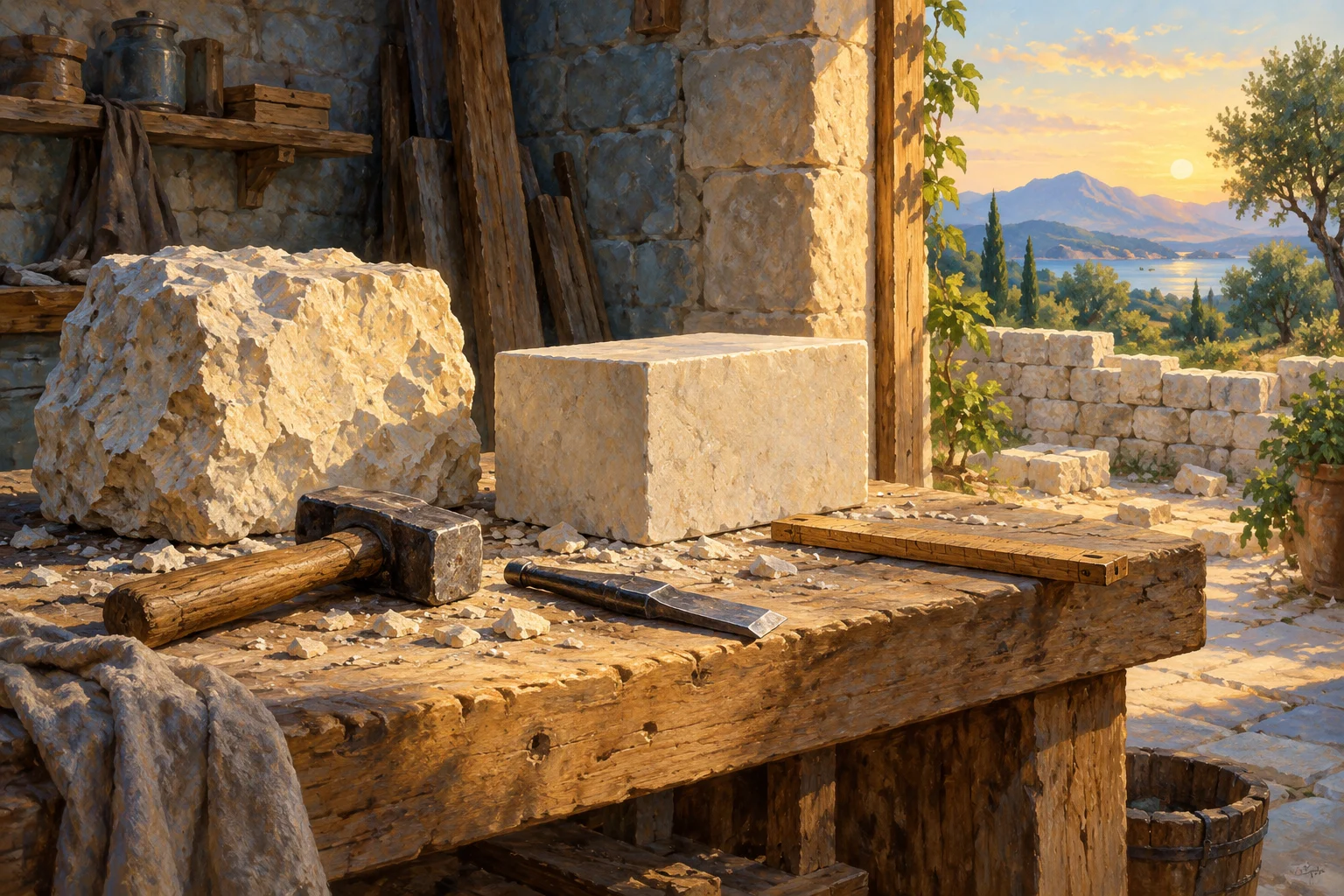
The rough ashlar is a stone awaiting the shaping that will fit it for building. Its companion, the finished or “perfect” ashlar, suggests the patient work between what we are and what we might become.
The rough ashlar holds possibilities that skill and patience can bring into use. Its value gives us a reason to work it. The finished stone points towards a character capable of bearing weight alongside others, while the distance between the two demands an honest assessment of ourselves. Where are the edges that need correction? What have we been excusing?
Consider impatience. From within, it can feel like efficiency: get to the point, make the decision, move on. From the other side of the conversation, it may feel like being dismissed before one has been heard. The rough edge is visible where lives meet.
Working that edge might begin with letting the other person finish, asking one real question, or admitting that the slower answer was the better one. Decisiveness becomes more useful when it can also listen. A small correction changes how the stone meets its neighbour.
This is why the building image matters. Other people must live with our character. An honest colleague, a patient father, a dependable friend makes it easier for others to carry their own responsibilities. Brotherhood gives that work a shared purpose: to become someone on whom another can rely.
The gauge, the gavel and the chisel
Three working tools give these lessons a practical shape. The Grand Lodge’s published educational manual discusses the twenty-four-inch gauge, the gavel and the chisel before turning to the Fellowcraft’s tools.
The gauge, a measuring rule, represents the day’s twenty-four hours. The manual asks us to exercise judgement in sharing time among worship, family, work, relaxation and self-improvement. For me, its challenge is to give those commitments a place in the day I actually live.
An ambitious person can understand the image and still evade its question. There is always another email, another task, another useful thing to build. Work expands until the people for whom we claim to be working receive only what remains.
The gauge asks us to look at the actual allocation. If service matters, where is its time? If rest matters, what has been allowed to displace it? If family matters, who has had to accommodate our refusal to stop?
The gavel, a mason’s hammer, brings correction within reach. The manual connects its work on the rough stone with the persistent effort to remove faults from our character. Pride and impatience are not usually overcome by one grand insight. We meet them in the next conversation and the next decision.
The chisel brings education into the image. The manual presents learning as a means of developing what lies within the mind. I read this as a reminder that effort needs instruction. Read the difficult passage again. Listen to the explanation. Learn how to make the next attempt more skilfully than the last. Refusing to learn can leave a man working hard at the same mistake.
For me, the three tools belong together: make time, accept correction, keep learning. The gauge gives the work its place in a day; the gavel supplies persistence; the chisel brings understanding to the effort. Together they turn an intention into something another person can depend on.
The dignity of the apron
The Masonic apron recalls a practical garment worn by working stonemasons. Ontario’s 2023 Book of Constitution specifies white lambskin for the Entered Apprentice’s apron. Its plainness keeps the image of labour close to the beginning of Masonic life.
Its force is easy to miss. The apprentice receives a reminder of work before he has achieved mastery. There is dignity in entering that work earnestly, without pretending to have finished it.
The person repairing a wall, tending a garden or making a piece of furniture encounters the resistance of material. The result must hold together. Writing and code deserve a comparable honesty: someone else must be able to read, use or maintain what we make. The apron brings status back to that tangible contribution.
The apron invites us to respect those forms of labour and the people who perform them. It also turns the question back on the wearer. What have I made more sound? Whose burden have I helped to carry? Honour has something to do with the answer.
A foundation for service
My Christian faith gives these reflections their purpose: to serve God through what I make and how I live. This is the commitment I bring to the work, among men whose religious beliefs may differ from mine.
The symbols become useful when they return us to ordinary obligations. Hear the person speaking. Correct the work that is not sound. Give time to the neighbour who needs it. Be willing to learn again where accomplishment has made learning uncomfortable.
The first degree gives this work a beginning and a direction. Humility makes instruction possible; practice gives the lesson substance; service gives the growing ability somewhere to go. The apprentice who learns to accept help is preparing to become the brother who can offer it.
We can accept the demands of beginning and return tomorrow more capable than we were today. That is a foundation worth laying.
The first stone does not contain the whole building. It gives the next stone somewhere sound to rest.
Further reading
- Grand Lodge of Canada in the Province of Ontario: Lodge Resources Manual, §21.3 (March 2009) — public educational discussion of the working tools; hosted by Zetland Wilson Lodge No. 86.
- Grand Lodge of Canada in the Province of Ontario: Book of Constitution, §387 (2023) — the Entered Apprentice’s apron; public copy hosted by Hugh Murray Lodge No. 602.
- United Grand Lodge of England: Why Freemasons Wear Aprons — background on the apron’s connection to working stonemasons.
Continue the original series
This essay opens Initiation & Transformation: From Apprentice to Architect. Continue with The Fellowcraft: Skill and Creativity, the second essay.