essay
The Fellowcraft: Skill and Creativity
View full artwork →
At first, a musician practises a scale to get the notes right. Later, the same notes help her hear why a phrase resolves or seems to ask for more. Eventually she can use that understanding to make something of her own. The exercise has barely changed. What she can find within it has.
That return interests me. We can revisit the same material for years without exhausting it, provided we bring more attention, experience and better questions each time.
Fellowcraft is the second of Freemasonry’s three foundational degrees. Ontario’s public educational manual describes it through the figure of the journeyman: someone developing the competence to contribute, still learning to judge the quality of his work.1 Between the willingness to begin and the responsibilities of mastery lies a long, necessary period of becoming useful.
I write as a Freemason, drawing on public teaching from the Grand Lodge of Canada in the Province of Ontario. The applications that follow are my own: how skill grows, how knowledge connects, and what we owe the people who will depend on what we make.
Returning with better questions
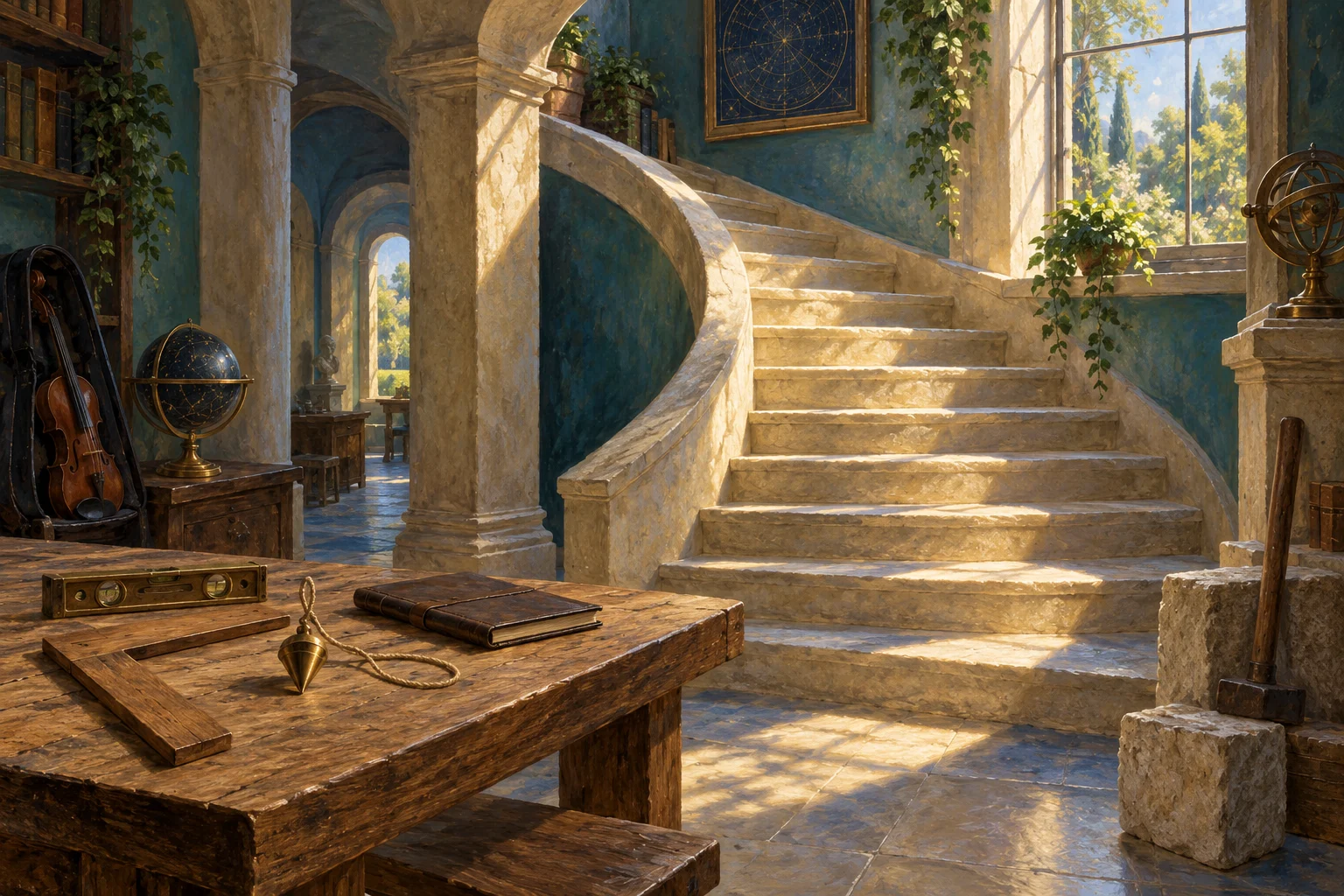
The winding staircase belongs to the Fellowcraft’s symbolism. In the Ontario manual, its concealed turns evoke the courage required to continue without seeing what lies ahead.1 I also see an image of learning: we return to familiar ground from a changed position.
Consider discounting in finance. A beginner learns to calculate what a future payment is worth today under a chosen rate. With practice, the arithmetic becomes easy. The harder questions come into view. Why this rate? How dependable is the payment? What would have to happen for the estimate to be wrong?
The calculation is still useful. Experience has made its assumptions more visible. Someone can operate a spreadsheet fluently and remain a beginner at judging what its answer means.
The musician makes a similar journey. Getting the notes right leaves room to notice timing, emphasis and the relation between phrases. She may return to a simple passage because it now exposes a weakness she could not previously hear. Progress sometimes looks like going back.
This is the demanding part of practice. Repeating what already sounds good can be reassuring; attending to the awkward passage can change what we are able to do. The writer faces the same choice in a paragraph whose claim is stronger than its evidence. Improvement begins where we stop protecting the appearance of competence.
Knowledge that belongs together
The degree directs attention to seven liberal arts and sciences: grammar, rhetoric, logic, arithmetic, geometry, music and astronomy.1 I value the breadth of that invitation. Expression, reasoning, number, form and the study of the heavens belong within the same intellectual life.
Specialisation has given us extraordinary abilities. It also leaves each of us responsible for understanding where our expertise meets someone else’s. A sound calculation may be explained badly. An elegant argument may depend on an unexamined number. A design can be technically successful while making life harder for the person expected to use it.
The connection becomes useful when it changes the work. Suppose an investment argument includes a confident growth forecast. Arithmetic helps calculate its consequences. Logic asks whether the conclusion follows. Clear language makes the assumptions available to someone who might challenge them. Each discipline gives the others a test they could not supply alone.
This is part of what I want from the Ledger: room for ideas to meet and improve one another. Finding a resemblance is a beginning. Working through its consequences is where the understanding develops.
Testing the work
The Fellowcraft’s working tools in Ontario are the square, the level and the plumb rule. The Grand Lodge’s manual associates them with morality, equality and upright conduct.2 Their practical work—checking an angle, a horizontal or a vertical—gives me a way to think about judgement.
The square turns my attention to the honesty of a transaction. Have I described what I am offering accurately? Have I included the limitation that might change another person’s decision?
The level asks whether I give people a fair hearing across differences in status. A senior colleague’s experience matters. So does the junior colleague’s accurate observation. Dismissing a correction because of who made it can leave the work weaker and the next useful objection unspoken.
The plumb rule asks what happens to principle under pressure. Will I acknowledge the mistake when a deadline is close? Will I apply the same standard when the result flatters me?
These are questions I have to answer through conduct. A physical square can establish a right angle; its moral image cannot settle every difficult decision for us. It asks us to acquire the judgement to examine those decisions honestly.
There is a particular satisfaction in becoming able to assess one’s own work. It also brings a temptation to stop seeking correction. The more capable I become, the more worthwhile it is to have someone who can still show me what I have missed.
Freedom through practice
Skill gives imagination something to work with. A sonnet’s fourteen lines create a definite problem for the poet. The shape asks for choices about pace, emphasis and where a thought should turn. A pianist’s technique gives a musical intention somewhere precise to go.
Constraints can produce frustration or invention. Their value depends on whether they serve the work. Learning a form well enough to use it gives us a better basis for deciding when to keep it, adapt it or leave it behind.
I bring that thought to building with AI. A system can offer a fluent paragraph or a plausible piece of code before I understand it. That speed makes judgement more valuable. I still need to know what the paragraph commits me to, how the code behaves, and whether either belongs in the thing I intended to make.
A useful limit might be simple: another person should be able to follow this explanation; this small program should solve one real problem; this page should make its purpose clear. Working within such limits can demand more imagination than adding another feature. The craft lies in making the result hold together.
What the work is for
In the wage symbolism described by Ontario’s manual, the Apprentice receives corn, wine and oil; the Fellowcraft receives coin. The manual then turns towards truth and knowledge as the deeper rewards of the work.1 What do we gain by becoming capable?
Fair payment matters. It supports the time and attention through which a person becomes good at something. My concern is with the life the work makes possible: enough provision to care for a household, enough room to enjoy the result, and the satisfaction of a contribution someone can trust. I would not turn that aspiration into a rule about what another person should earn.
Competence also needs somewhere to belong. A community can praise skilled work while giving a newcomer little opportunity to attempt it. It can do better by offering a real task, patient instruction and responsibility that grows with ability. The learner, in turn, has to show up, accept correction and finish what he has undertaken.
This is why I resist treating the middle stage as something to hurry through. There is a life’s worth of work in becoming skilful, making sound judgements and helping another person learn. Our best efforts can give someone else a more secure place to begin.
The third essay in this series turns towards integrity, mortality and what we leave behind. Here I want to stay with the work in our hands: the passage that needs practice, the assumption that needs testing, the person waiting for us to finish something well.
The staircase brings us back to familiar questions. We owe them a better answer than we could give before.
Second in Initiation & Transformation: From Apprentice to Architect. Begin with The Entered Apprentice; continue with The Master Mason: Integrity and Legacy. Related reading: The Unmaking of Men considers how communities make room for useful responsibility.
Footnotes
-
Grand Lodge of Canada in the Province of Ontario, Lodge Resources Manual, §3.12, pp. M20–21 (March 2009). Public copy hosted by Zetland Wilson Lodge No. 86. Supports the degree’s place, liberal arts, winding stair and Ontario wage symbolism. The learning and work examples here are personal applications. ↩ ↩2 ↩3 ↩4
-
Grand Lodge of Canada in the Province of Ontario, Lodge Resources Manual, §21.3, pp. OGL6–7 (March 2009). Public copy hosted by Zetland Wilson Lodge No. 86. Supports the square, level and plumb rule and their moral associations; the practical questions in this essay are my interpretation. ↩