
atlas
Christian Art: An Atlas of Unfamiliar Skies
View full artwork →
Here is the complete collection: twelve historical artwork groups, from a Florentine Madonna to the church panel at Sighișoara. The shapes that drew me in are easy to name—discs, domes, suspended globes and shafts of light. I believe their resemblance to forms described in anomalous aerial encounters is worth pursuing. This atlas puts the pictures in front of you so that you can follow the connection for yourself.
Begin with the detail that catches your eye, then return to the whole scene. Each entry keeps the artwork, its recorded setting and a question for closer looking together. The hat and the clouds stay in the collection too: a comparison is more interesting when the differences are visible.
Eleven groups have images here. Sighișoara has a named entry with links to its panel and surrounding triptych; permission to reproduce those photographs has not been established. Salimbeni is represented by the supplied upper detail, and Beaune by selected scenes from its larger tapestry cycle. The unauthenticated Instagram scene and TMZ’s presentation appear separately at the end.
Choose an artwork below. For the argument behind the collection, read the personal essay. The methods and comparisons explain how the images were studied.
Choose an artwork
- Florentine Madonna — an oval above a watcher
- Dečani — the paired celestial figures
- Crivelli — a ray crossing a city
- Masolino — a procession of clouds
- De Gelder — the oval and descending light
- Salimbeni — the globe and sceptres
- Svetitskhoveli — two forms beside the cross
- Uccello — a recognisable cardinal’s hat
- Raphael — a fiery mark above the town
- Piero — clouds, dove and bowl
- Beaune — two cap-and-brim motifs
- Sighișoara — the panel and its triptych
01. Madonna and Child with the Infant Saint John
Florentine school; attribution disputed · Around 1500; catalogue ranges differ
Museo di Palazzo Vecchio, Florence
Look closely. Follow the distant figure’s gaze. What does the surrounding landscape add to the tiny oval?


A tiny dark oval hangs in the landscape beyond Mary’s shoulder. Its isolation in the sky, together with a shepherd and dog apparently looking upward, makes it a compelling place to pause. The round devotional painting belongs to a Florentine tradition of placing sacred events within familiar landscapes. Comparisons with other Nativity images suggest a luminous cloud announcing the divine presence, although no distinct angel can be resolved inside this particular form. The oval itself remains small and softly defined in available reproductions. Its modern saucer resemblance is clearest at the level of outline. Even the artist’s identity is unsettled: catalogues have proposed Mainardi and members of the del Sellaio circle, with differing date ranges around the turn of the sixteenth century.


Sources and further looking: Italian cultural-heritage catalogue Fondazione Zeri catalogue Diego Cuoghi: the luminous-cloud comparison.
02. The Crucifixion at Visoki Dečani
Anonymous Byzantine/Serbian workshop painters · c. 1340s; fresco campaign 1338–1348
Visoki Dečani Monastery, Dečani/Deçan, Kosovo
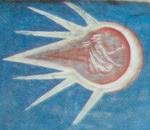
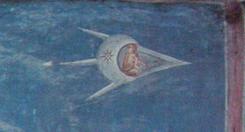
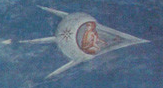
Look closely. Look at both upper corners. How does the pair change the impression of a lone occupied craft?
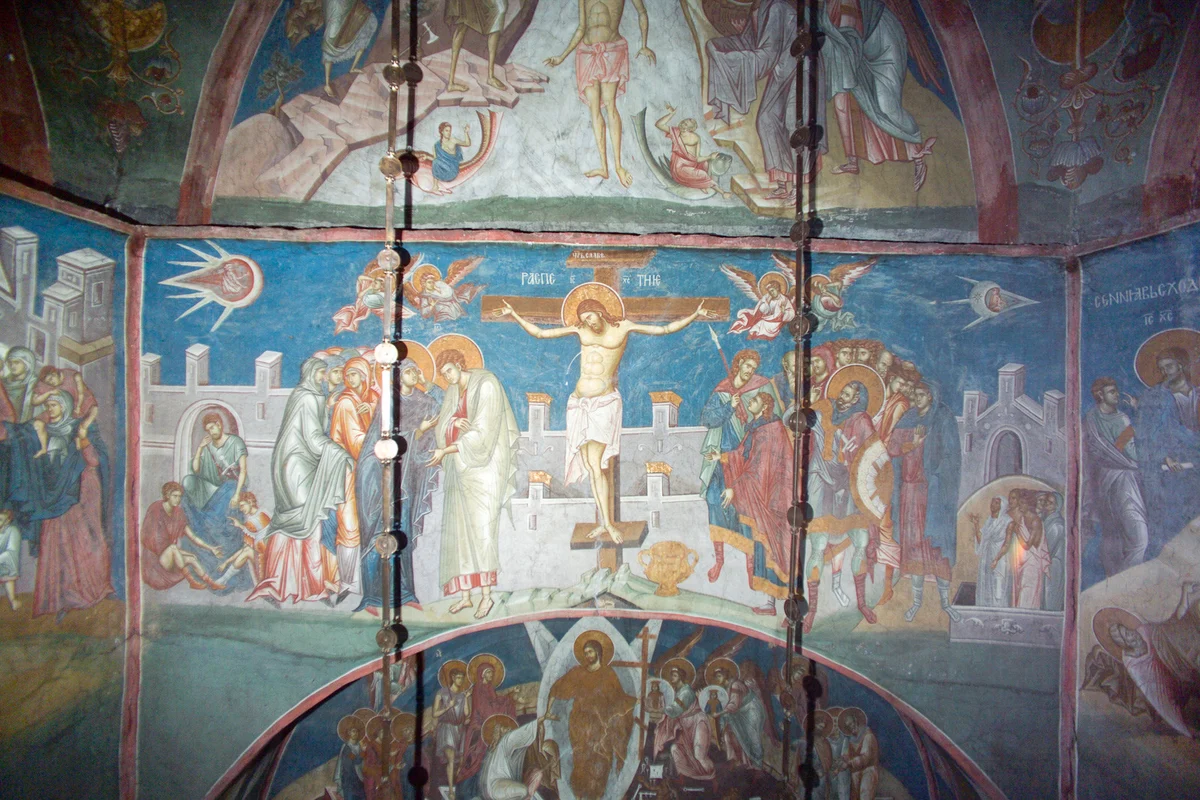
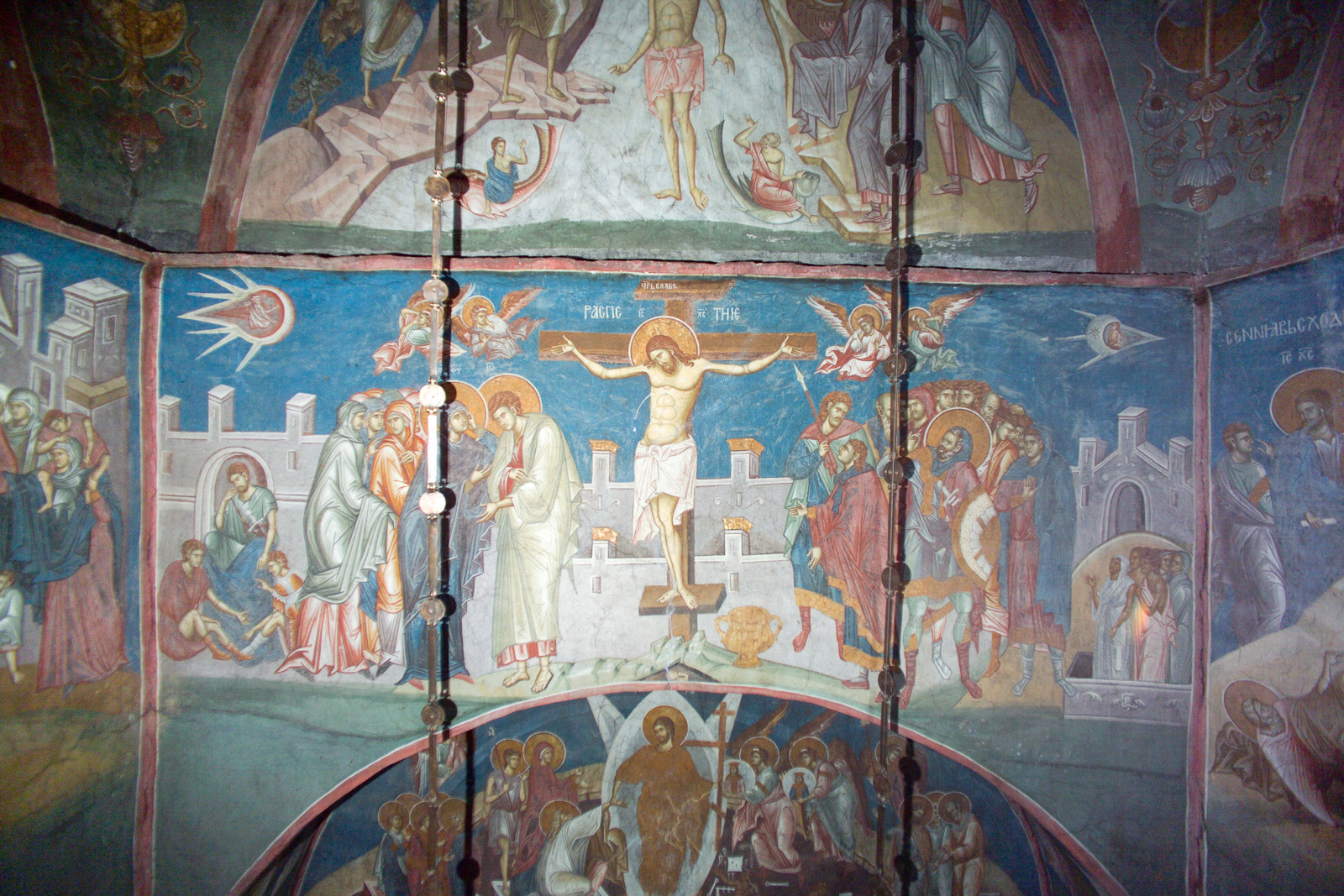
Two small human figures inhabit pointed celestial forms on either side of the Crucifixion. Seen alone, their enclosures can resemble occupied craft, while the long rays suggest movement. In the complete fresco, their balanced positions beside Christ become an essential clue. Direct research on the Dečani imagery identifies them as personifications of the Sun and Moon, drawing on traditions that gave celestial bodies human forms. The painting belongs to the monastery’s extensive fourteenth-century fresco campaign, carried out by multiple painters. Its exact year is less certain than that broader chronology. The visual connection with a tailed or enclosed flying form remains striking; the accompanying figures, paired arrangement and Crucifixion setting explain why an outline-only comparison leaves out so much.


Sources and further looking: Visoki Dečani: the fresco campaign Research on Dečani’s Sun and Moon BLAGO photographic archive.
03. The Annunciation, with Saint Emidius
Carlo Crivelli · 1486
National Gallery, London · NG739
Look closely. Trace the ray all the way into Mary’s room. Then look for the city held in Saint Emidius’s hands.


A ring in the upper-left sky sends a fine golden line through an opening in Mary’s wall. That combination of an oval source and directed light has an immediate resemblance to a disc-and-beam scene. Follow the line into the room, however, and a small dove becomes visible: the National Gallery identifies it as the Holy Ghost arriving at the Annunciation. Crivelli’s painting also celebrates Ascoli Piceno, where news of the grant of self-government arrived on the feast of the Annunciation in 1482. Saint Emidius presents a model of the city beside Gabriel. Signed and dated 1486, the work offers unusually secure historical bearings. Its meticulously ordered architecture makes the passage between heavenly and everyday space feel almost physically precise.

I read this as a picture with two announcements: the sacred event and the city’s remembered news. The beam connects heaven and a room; Saint Emidius’s model connects the room to a civic history.
Sources and further looking: National Gallery object record National Gallery: entering Crivelli’s picture.
04. The Foundation of Santa Maria Maggiore
Masolino da Panicale · 1428–1429 in the Zeri catalogue; also dated 1427–1429
Museo e Real Bosco di Capodimonte, Naples
Look closely. Move between the largest cloud and the smaller procession across the sky. Which contours repeat?


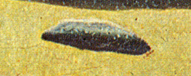
A broad grey cloud stretches beneath Christ and Mary, while smaller flattened clouds recede across a gold sky. Their repeated rounded tops and narrow lower edges readily evoke a fleet of discs. Below, Pope Liberius marks out a church’s footprint in white snow. The scene recounts the foundation legend of Santa Maria Maggiore, in which a miraculous summer snowfall identifies the site of the Roman basilica. This panel once formed part of the altarpiece made for that church and is now in Naples. Catalogues place it around 1428–1429, with a slightly wider range also used. Its clouds belong to a highly organised sacred landscape, making it a useful comparison for how repeated natural forms can acquire a strongly geometric appearance.

Sources and further looking: Fondazione Zeri object catalogue Vatican News: images of the snow miracle.
05. Baptism of Christ
Arent (Aert) de Gelder · c. 1710
Fitzwilliam Museum, Cambridge
Look closely. Look inside the oval before following the light down to the water. Can you pick out the dove?
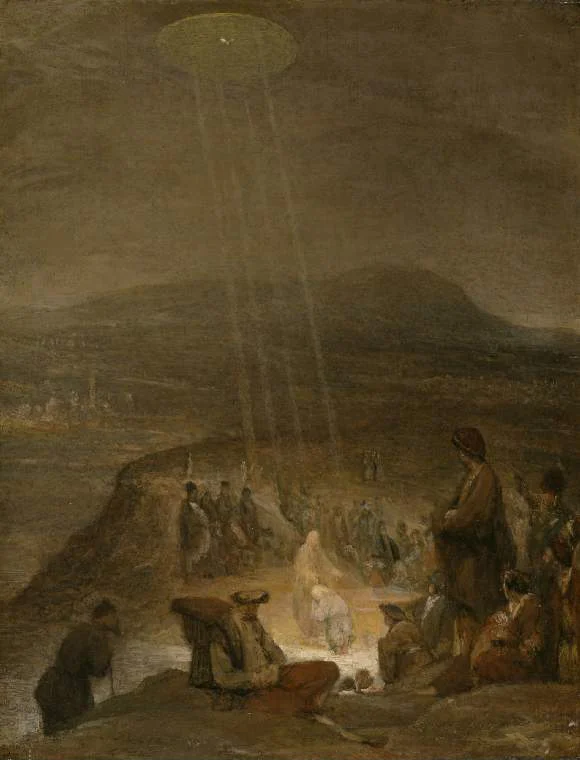


The dark sky opens into an oval ring, with long shafts of light reaching the small baptism scene below. At the centre of that opening is a white dove. The ring-and-rays arrangement has a strong visual connection with modern disc-and-beam imagery, especially when the upper portion is isolated. Within the Gospel subject, the dove identifies the Holy Spirit, while the descending light joins the heavenly sign to Christ. De Gelder’s subdued landscape gives the illumination particular force. The Fitzwilliam dates the painting to about 1710 and records its gift to the museum in 1905; its first commission remains unestablished here. The work rewards looking at the entire light path, where the relationship between source, dove and baptism becomes clear.


Sources and further looking: Fitzwilliam Museum catalogue Diego Cuoghi: baptism and dove comparisons.
06. Glorification of the Eucharist
Ventura Salimbeni · 1600
San Lorenzo in San Pietro, Montalcino
Look closely. Follow the rods outward to the hands that hold them. What changes when the globe returns to the Trinity?


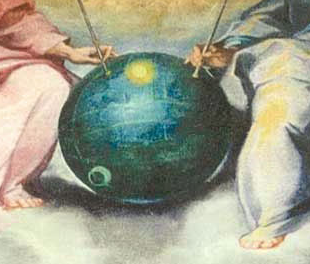
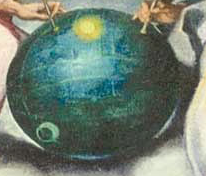
A blue sphere suspended between the Father and Son, crossed by two slender rods, can look unexpectedly familiar in the age of satellites. The rods continue into the figures’ hands: they are sceptres, and the sphere represents Creation or the cosmos under divine authority. Small solar and lunar details broaden its meaning beyond a simple map of Earth. Above it, the dove completes the Trinity. Salimbeni painted this altarpiece for the church where it remains; the national heritage record documents his signature and the Jubilee year 1600. The sphere-and-rods resemblance is visually clear, while the hands and surrounding figures identify the symbolic relationships. The supplied image shows the upper Trinity and globe, not the complete altarpiece. The linked parish and heritage records restore its wider setting.
Sources and further looking: Italian cultural-heritage catalogue Montalcino parish: San Pietro Municipality of Montalcino Comparative Trinity imagery.
07. The Crucifixion at Svetitskhoveli
Unknown painter · Probably 16th–17th century; paint layer uncertain
Svetitskhoveli Cathedral, Mtskheta, Georgia
Look closely. Compare the red and pale forms on either side of the cross. Their relationship is part of the picture.


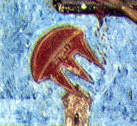
A red cap and a pale cap hover beside Christ’s outstretched arms, each ending in long pointed forms. At close range they can suggest bells, canopies or jellyfish-like silhouettes. Their place on opposite sides of the cross is a stronger historical clue than their outline alone: the pair fits the long Christian tradition of depicting the Sun and Moon at the Crucifixion. This reading is comparative and less directly documented for this exact fresco than for Dečani. The cathedral’s medieval foundation cannot date every layer of its wall paintings, and the selected scene is usually placed much later, probably in the sixteenth or seventeenth century. Keeping that uncertainty visible preserves the distinction between a recognisable visual convention and a securely dated individual object.


Sources and further looking: Photographic record and print source Princeton: Svetitskhoveli Cathedral Sun and Moon in Crucifixion imagery.
08. Allegory of Monastic Life
Paolo Uccello, current museum attribution · c. 1460–1465
Galleria dell’Accademia, Florence
Look closely. Find the red brim and its cords in the hermit’s recess. Keep this recognisable hat beside the less settled shapes.
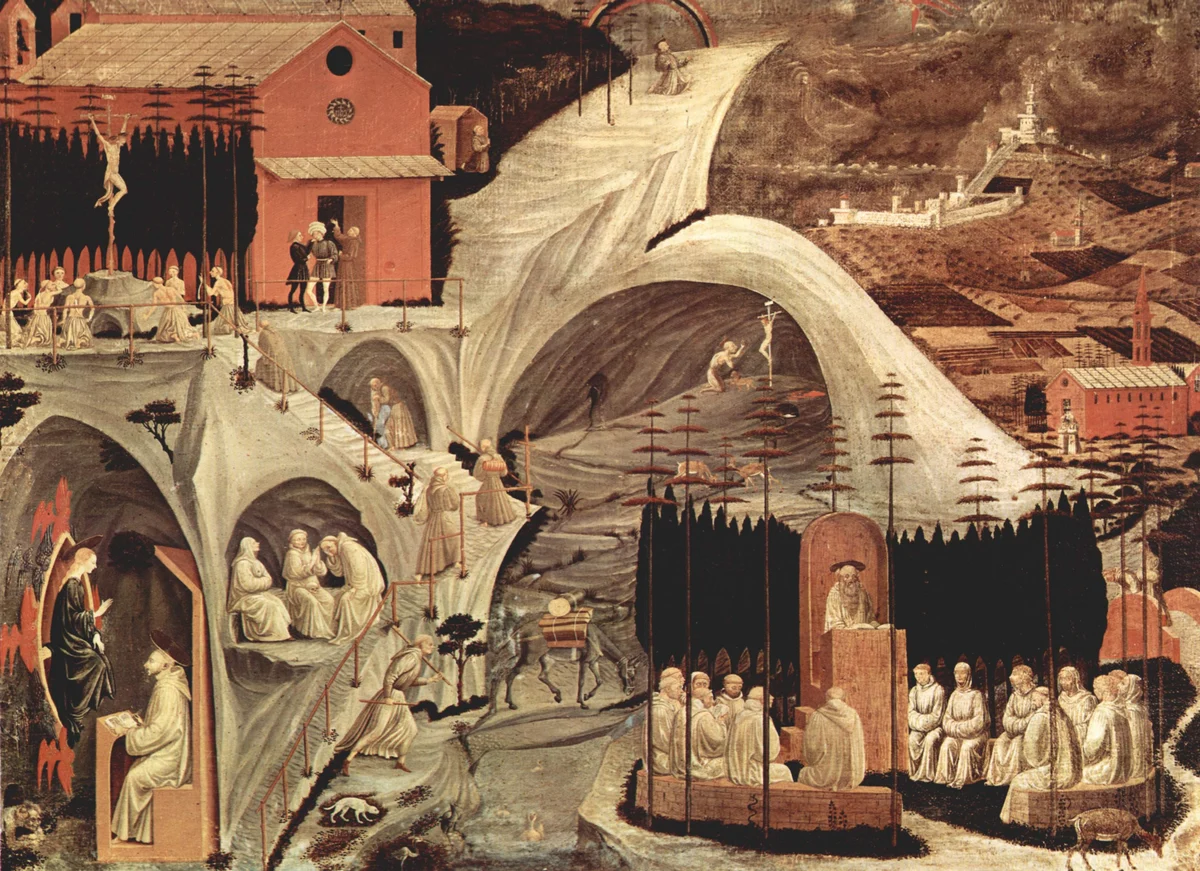


In a rocky recess, a small red form combines a raised centre, a broad brim and thin trailing cords. Removed from its surroundings, that outline can resemble a compact saucer. The recess contains Saint Jerome in penance, and the red object is his cardinal’s hat, a familiar attribute in images of the saint. The cords and its position beside the cross become easier to read in the larger scene. The museum currently attributes this landscape of solitary religious life to Paolo Uccello and dates it around 1460–1465. It came from San Giorgio alla Costa, although its original patron and intended setting remain uncertain. Here the shape comparison is particularly instructive: a brim and crown supply the same simple geometry that attracts attention elsewhere in the atlas.


Sources and further looking: Galleria dell’Accademia object record Italian cultural-heritage catalogue Cardinal’s-hat visual comparisons.
09. Madonna of Foligno
Raphael · 1511–1512
Pinacoteca Vaticana, Vatican Museums
Look closely. Look below the heavenly figures, toward the distant town. The small fiery mark belongs to a different visual family from the domed forms.


Below the Virgin’s great golden glory, a tiny fiery mark descends over the distant town. Its bright head and tapering streak invite comparison with a fireball or a tailed light. The Vatican Museums connect the commission to Sigismondo de’ Conti’s thanksgiving after his house was struck by lightning. That account supplies the devotional setting, while the small painted mark leaves the precise appearance of the event beyond recovery. Raphael made the work for Santa Maria in Aracoeli in Rome; it later travelled to Foligno and France before entering the Vatican collection in 1816. Its distant landscape detail shows how much interpretive attention can gather around only a few strokes of paint.
Sources and further looking: Vatican Museums object record.
10. The Baptism of Christ
Piero della Francesca · Probably c. 1437–1445, current museum dating
National Gallery, London · NG665
Look closely. Compare the dove, clouds and baptismal bowl. Similar outlines can belong to different things in one picture.


Several of Piero’s clouds spread into long horizontal bands with gently raised centres. A foreshortened white dove above Christ creates another flattened silhouette nearby. The National Gallery explicitly identifies the clouds and the dove, which represents the Holy Spirit. These familiar elements make the painting a valuable comparison for the more ambiguous shapes elsewhere in the atlas: a rounded upper profile and a thin lower edge can arise within an ordinary cloud convention, while a bird’s open wings produce a similar crosswise span. Made for a church in the artist’s hometown of Borgo Sansepolcro, the panel is now dated by the museum to probably about 1437–1445. Its calm, carefully balanced sky offers a clear view of resemblance without requiring every similar outline to share the same subject.


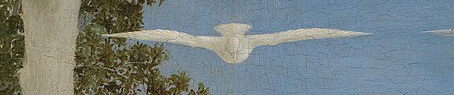
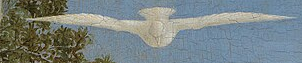
Sources and further looking: National Gallery object record National Gallery audio description.
11. Life of the Virgin: two tapestry skies
Unknown tapestry workshop · 1500, recorded in a woven inscription
Collégiale Notre-Dame, Beaune
Look closely. Find the cap-and-brim form in each tapestry scene. What persists when the surrounding episode changes?

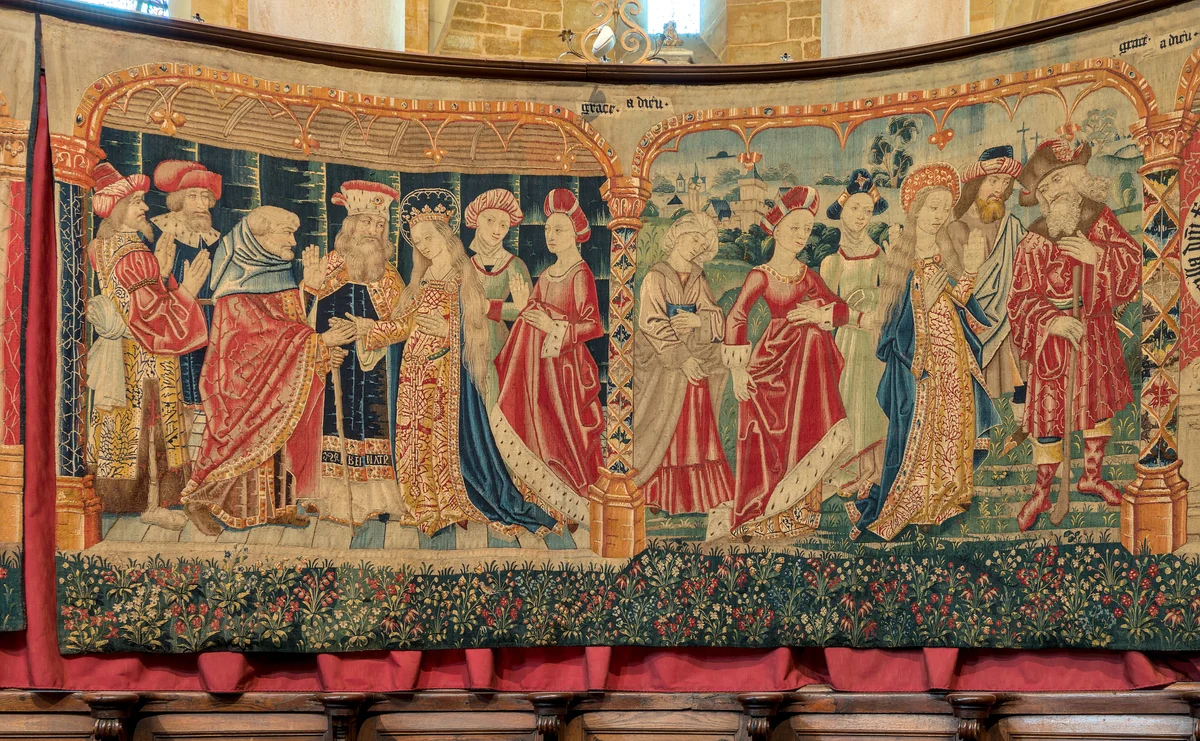
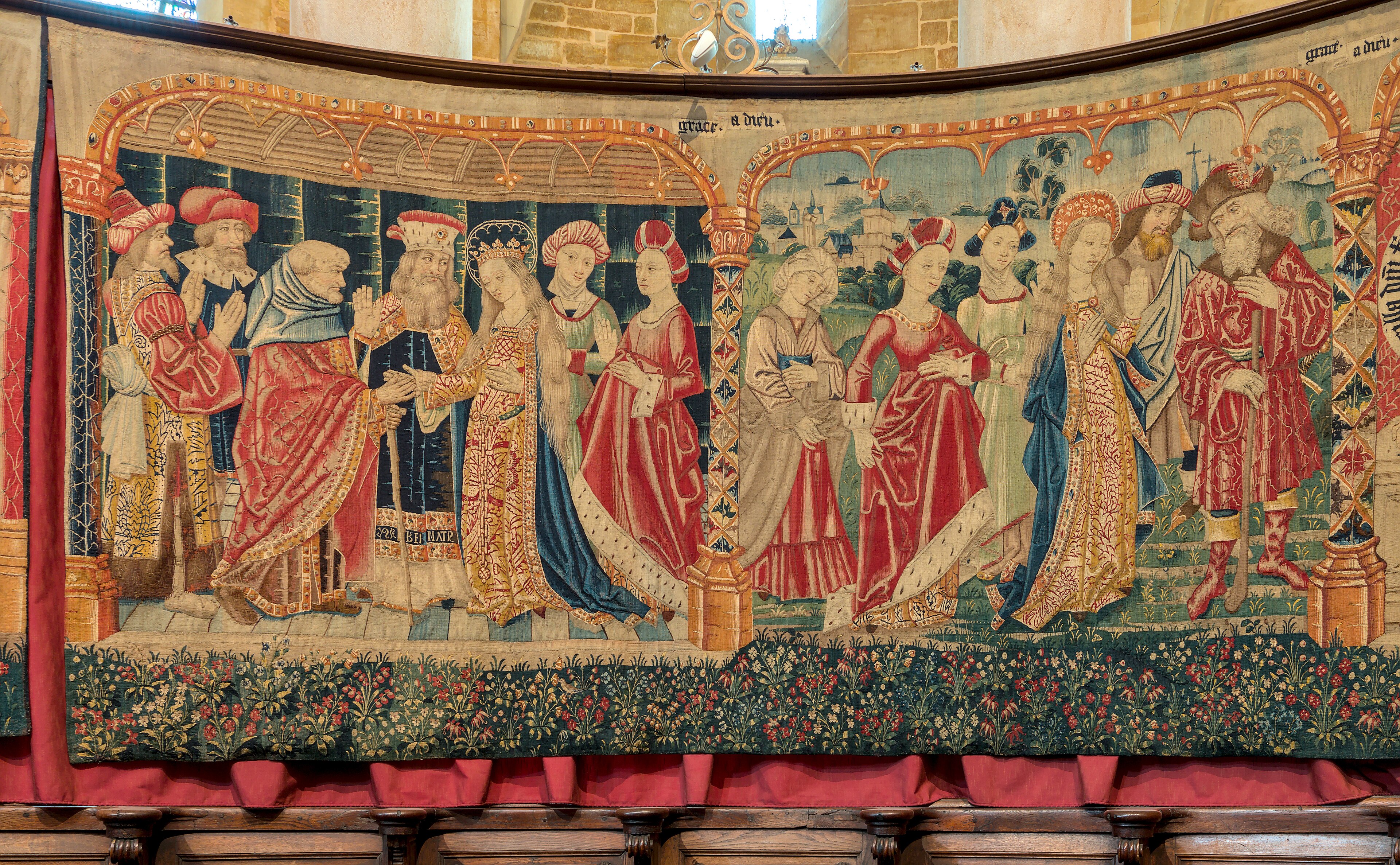
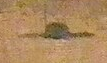
High above the figures, a tiny dark shape has a broad rim and a raised central cap. It appears in two scenes of the Beaune cycle: Mary going to Joseph’s house and the Visitation. The resemblance to both a brimmed hat and a domed saucer is unusually clear, even within the richly patterned textile. Five hangings were donated by Hugues Le Coq in 1500, a date supported by a woven inscription. Their maker is unknown, and a proposed connection with Pierre Spicre’s designs remains uncertain. A stylised cloud and a cardinal’s-hat allusion have both been suggested for the small motif, but the official object record does not settle its meaning. The repeated form deserves comparison across the whole cycle, where landscape and devotional storytelling remain inseparable.



Sources and further looking: French Ministry of Culture object record Bourgogne–Franche-Comté heritage publication Research on the tapestry’s attribution Scene and motif discussion.
12. “Israel, hope in the Lord”: the Sighișoara panel
Unknown; local workshop suggested · 18th century, according to local museum testimony
Monastery Church, Sighișoara, Romania
Look closely. Open the panel and triptych photographs side by side. Compare the rim, pointed underside, upper attachment and inscription.
View the triptych and church context
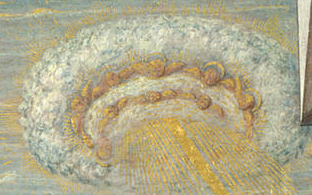
In the linked photograph, a grey ribbed oval hangs above a red-roofed church within curling clouds. Its rim and pointed central boss create a persuasive disc-like silhouette, while an ochre attachment connects it to the cloud area above. The inscription quotes Psalm 130:7, “Israel, hope in the Lord.” This is the central scene of a religious triptych. Local museum director Nicolae Teșculă dates it to the eighteenth century; an exact year, artist and painting technique remain unverified. Local interpretations differ between a shell-shaped cloud and an offering vessel with smoke. A shield held from the clouds also offers a useful period comparison, although no direct model has been demonstrated. The composition keeps both a clear visual resemblance and an unresolved historical question in view.
Sources and further looking: 2016 interview with the museum director 2025 museum and parish interviews A dated heavenly-shield comparison.
A separate image with an open provenance question
A giant domed disc, concentric underside and descending light fill the sky above haloed figures. The resemblance to familiar saucer imagery is unusually explicit. Rated Red’s two-slide Instagram carousel presents the same scene twice and describes it as roughly 950 years old. The reviewed source chain does not identify a monastery, artist, inventory number or conservation record that connects this exact image to an eleventh-century object. A later article repeats the scene while switching to the distinct Sighișoara church panel in its discussion, adding a further provenance complication. The image remains a useful example of how historical claims circulate with striking visuals. Its maker, creation date and production method are undetermined, so it is kept beside the historical atlas as a separate case to investigate.
View the exact Instagram carousel · Compare the later article and its change of subject.
The artworks in the TMZ coverage
TMZ’s 2024 video coverage moves between six historical compositions, now found in Florence, London, Cambridge, Naples and Sighișoara. Repeated close-ups can make the selection appear larger. The exact Facebook post was a link post; the separately inspected video belongs to the corresponding TMZ coverage. The atlas uses independent artwork reproductions where their public reuse status is documented, while the publisher’s presentation remains available at its source.
Read TMZ’s article · Watch the separately inspected TMZ video · View the Facebook link post.
What to carry into the comparison
A disc-like outline occurs in several settings: a stylised cloud, a heavenly opening, a cap, an emblem, or an unresolved distant detail. Rays can signal light, movement or divine presence. Pairing the close view with the whole composition keeps those relationships available.
Continue with the methods and comparison findings. The research summary records the study’s scope, crop coordinates, model settings and qualified connections; the source bibliography preserves the wider source trail.