
case notes
Washington, 1952: returns over the capital
View full artwork →
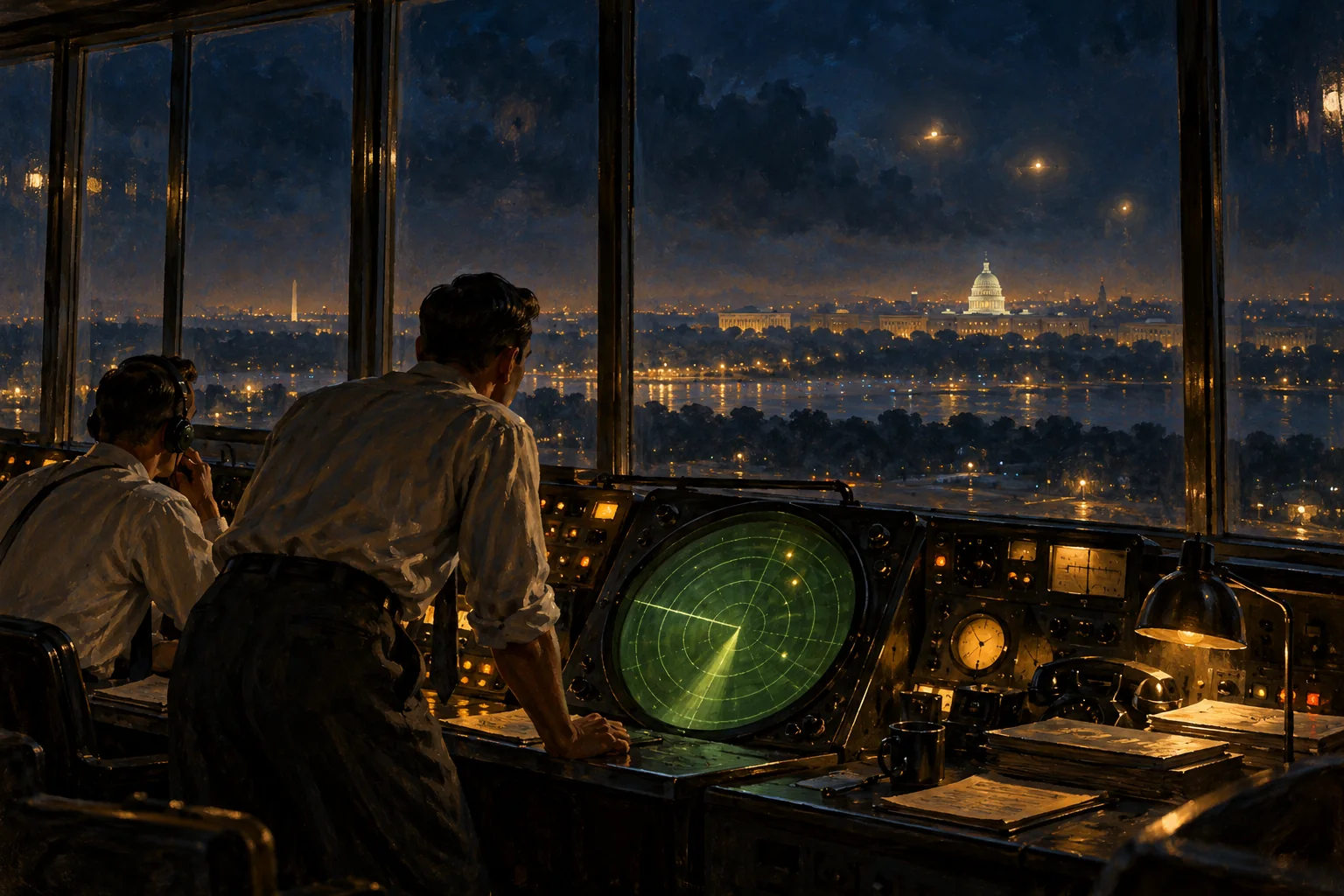
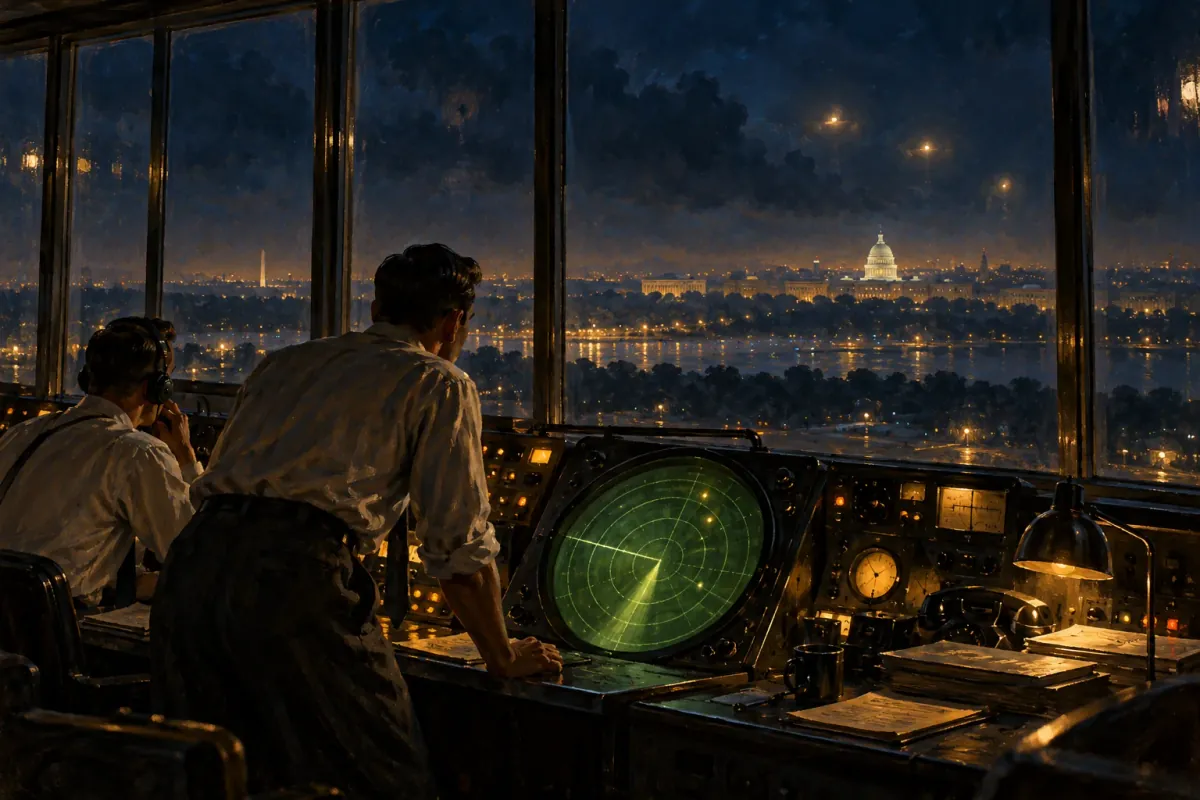
Late on a July Saturday, the people watching Washington’s air traffic had something on their screens that they could not readily place. Aircraft were still coming and going. Alongside that familiar traffic were unexplained returns, while some crews and tower observers reported lights in the sky. A week later, the capital went through another night of reports and attempted interceptions. The question moved from the radar room to the Pentagon’s press room.
Follow the case: the two weekends · the weather explanation · read the record.
Two weekends over Washington
The best-known episodes span 19–20 and 26–27 July 1952. In his later account, Blue Book chief Edward J. Ruppelt describes the first National Airport reports beginning at 11:40 p.m., with unexplained targets on two radars. Airliner crews and tower personnel also reported lights. Interceptors were brought in. Ruppelt’s narrative then returns to the following weekend, when controllers again tracked unknown returns and fighters again tried to investigate.1
That sequence gives the case its force: people responsible for separating aircraft were trying to reconcile what appeared on a scope with what someone could see outside. Yet a radar return and a light become one observation only if their time, direction and position can be matched. The familiar phrase “saucers over Washington” compresses several stations, two weekends and many reports into a single picture.
The surviving Project Blue Book material belongs to the National Archives. Its collection guide explains the custody of those records; the Washington case directory links readers onward to material about the individual nights.2 Ruppelt’s book is a participant’s retrospective account, not the original radar log. Harry Barnes’s contemporary report describes equipment checks and repeated calls for interception, with uncertainty over which office would act.3
What the weather explanation actually addresses
On 29 July, Major General John A. Samford addressed the reports at a Pentagon press conference. The Air Force offered atmospheric propagation as a leading possibility: temperature inversions could produce misleading radar returns, while ordinary lights might account for visual reports. At the same conference, radar specialist Captain Roy James acknowledged that the available information did not establish inversion as the definite cause or permit precise fixes between stations.4
The physical possibility matters. Radar does not draw a direct photograph of the airspace. An explanation involving propagation asks whether the atmosphere could have made an ordinary situation look extraordinary to the instrument. It still has to fit a particular record. Conversely, a controller’s confidence that a return looked solid does not establish what produced it.
The unresolved work is therefore more interesting than choosing between a fleet of craft and a blanket dismissal. Take one return, one visual report and one attempted interception. Can they be lined up? Do the surviving records preserve enough information to distinguish weather, ordinary traffic and something not yet identified?
Read the record
Start with Ruppelt’s chapter, “The Washington Merry-Go-Round”, then use the Washington case directory to separate the documents from the later narrative. The National Archives guide is the route back to the official collection, rather than a verdict on the lights.
Continue to Lakenheath–Bentwaters for a night when an interceptor reportedly became the pursued aircraft. Or follow the Belgian wave to see why a ground sighting, a radar lock and a famous photograph must be examined separately. Return to all cases.
Footnotes
-
Edward J. Ruppelt, The Report on Unidentified Flying Objects, chapter 12, 1956. A retrospective account by the former head of Project Blue Book, including the two Washington weekends, the press conference and disagreement about the weather explanation. His narrative and judgements are attributed here, not treated as a preserved radar measurement. ↩
-
U.S. National Archives, “Unidentified Flying Objects”. A finding aid for Project Blue Book, whose Washington records are also indexed in NICAP’s Andrews / National directory. ↩
-
Harry G. Barnes, National Airport radar report for 19–20 July 1952, reproduced scan. A controller’s contemporary account of targets, equipment checks and requests for interception, not an identification of the returns. ↩
-
Transcript of the 29 July 1952 Pentagon press conference, public reproduction. Captain James distinguishes possible propagation effects from a definite explanation of these returns and describes limits on the available cross-station records. ↩