
essay
The Institutions That Held the Line
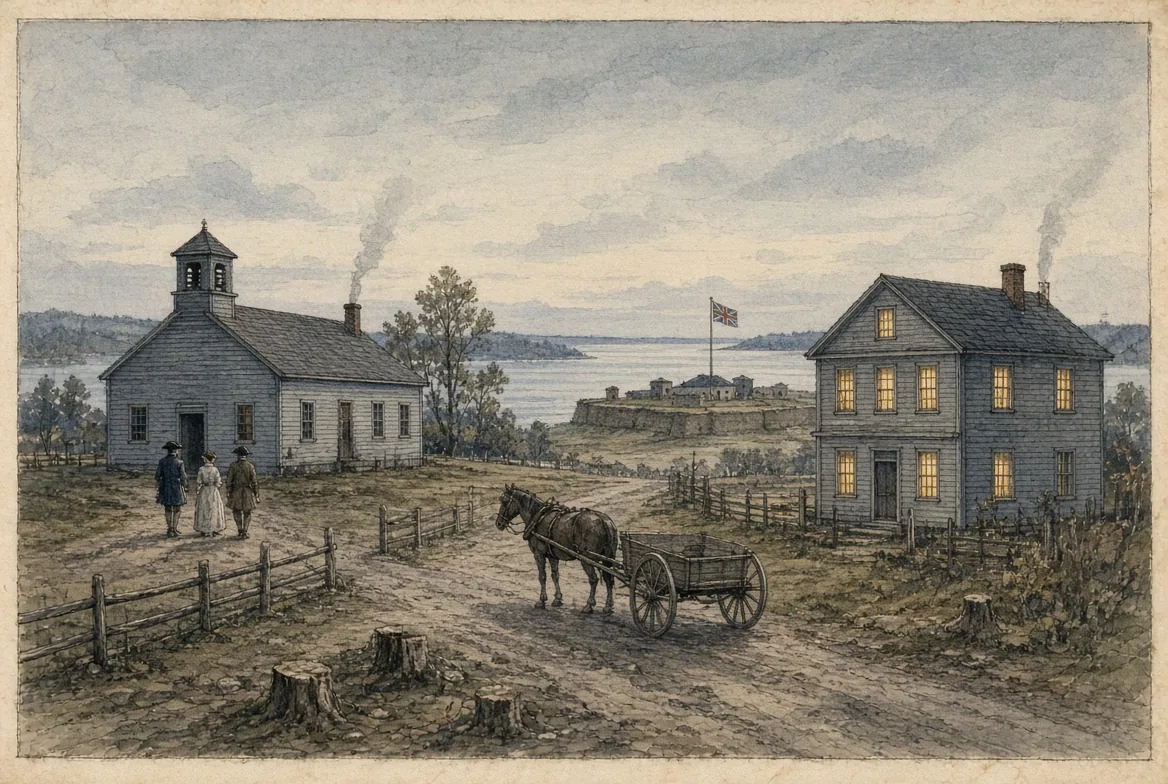
View full artwork →
“No family is an island. The line endures because institutions endure—and institutions endure because they demand something of their members.”
Across eight generations, the Dawson family story runs through St. George’s parish in Kingston, Masonic lodges and the civic life of Ontario. These institutions helped carry an inheritance that no household could sustain alone: moral formation across lifetimes, memory across centuries, and accountability that survives the death of any individual member.
My argument is that institutions preserve a culture when they ask for commitment, keep memory alive through practice, and build for people who will come after them. Church and lodge give this argument its shape in my own family. The Dawson family history supplies the people and places behind it.
I. The Problem: Entropy Is the Default
Entropy offers an image for what happens when a family or institution stops renewing its practices. The comparison is an analogy, not a physical law of family life: what matters here is the work needed to keep knowledge and commitments alive.
Cultural entropy takes specific forms: skills are lost when they are not transmitted. Values drift when they are not practiced. Institutions hollow out when membership becomes frictionless. Faith traditions evaporate when they demand nothing. In my family, grandfather James Glen was a Freemason during the Craft’s postwar peak and held that connection through its decline. The thread lapsed in my father’s generation, while Anglican practice weakened and the genealogical archive became scattered.
The secular cycle theorists—Strauss and Howe, Turchin, Spengler—describe this entropy at civilizational scale. Turnings recur. Elites overextend. Institutions lose legitimacy. Social capital depletes. The diagnosis is structural and, they argue, inevitable.
But the diagnosis is incomplete. It describes the decay without explaining the mechanism of repair. If entropy is the default, what reverses it? What are the institutions that push back against dissolution?
The answer is not abstract. It is architectural. Specific institutions, built on specific principles, perform the work of cultural maintenance that no market, no government, and no individual family can sustain alone.
II. The Guild Principle: Formation, Not Training
The first principle is that institutions which form persons—rather than merely transferring skills—produce durable change.
A fourteen-year-old enters a goldsmith’s workshop in 1350 Bruges. Seven years later, he emerges a different person. The guild did not merely teach technique. It restructured identity. The apprentice ate with the master’s family, adopted the guild’s moral code, submitted to graduated thresholds of competence that were publicly assessed and ritually marked. The masterpiece was not just a demonstration of skill—it was a threshold crossing, an initiation into a new mode of being.
Modern institutions have largely abandoned this model. Professional certifications can become tests of knowledge alone; university degrees can become signals of completion. Both can also support serious formation when teachers, practice and standards remain at their centre. The guild’s insight—that formation requires sustained proximity, graduated challenge, and ritualized progression—has been replaced by the efficient transfer of information.
Freemasonry preserved the guild model when the operative lodges gave way to speculative ones. The degrees of Entered Apprentice, Fellowcraft, and Master Mason are not information transfers. They are formation experiences—ritual enactments that restructure the candidate’s relationship to moral truth through physical and symbolic action. The working tools are not metaphors to be understood but instruments to be used: the level teaches equality, the plumb teaches uprightness, the square teaches moral rectitude.
The Dawson line’s Masonic thread illustrates this formation principle across eight generations. It was maintained through the Craft’s expansion and peak, then lapsed for a generation. My initiation at Harcourt Lodge No. 581 in 2022, followed by being raised to Master Mason in 2024, restored that connection as a living practice.
The through-line: Institutions that merely train produce employees. Institutions that form produce persons capable of transmitting virtue.
III. The Cathedral Principle: Building Beyond Your Own Horizon
The second principle is temporal. Institutions that endure are those built on a timescale that exceeds any individual member’s life.
Chartres Cathedral took sixty-six years to build. Three generations of stonemasons worked on it. No one who began it lived to see it finished. That was the point. The cathedral builder’s philosophy is not impractical idealism—it is the only timescale on which certain kinds of work can be done. You cannot build a cathedral in a sprint. You cannot form a civilization in a generation. You cannot transmit virtue without planting trees you will never sit under.
Modern culture operates on the opposite timescale. Move fast and break things. Quarterly earnings. Annual reviews. Election cycles. These are not just different speeds—they are different theologies. They encode a belief that meaning is consumed rather than constructed, that value is extracted rather than compounded.
The Dawson line’s eight-generation continuity is itself a cathedral project, whether the earlier generations knew it or not. James’s 1807 Crown patent was the foundation stone. Each subsequent generation added courses. The present bearer does not complete the building—he lays the courses that the next generation will build upon.
But cathedral time requires institutional support. No family sustains multi-generational projects alone. The Church provided the liturgical calendar that sanctified cyclical time—Advent, Lent, Ordinary Time, year after year, the same readings and the same rhythms deepening through repetition rather than decaying through familiarity. The Lodge provided the degree structure that marked progression across years rather than weeks.
The through-line: Short-termism is institutional entropy by another name. Institutions that build on cathedral time compound; institutions that optimize for the quarter depreciate.
IV. The Memory Principle: Ritual Over Database
The third principle concerns how institutions remember.
Institutions remember through rituals, not databases. The annual review, the onboarding orientation, the quarterly report—these are liturgies, whether their practitioners recognize it or not. They encode what matters by rehearsing it repeatedly in structured form. Documentation without ritual is dead letter. Minutes filed but never read. Policies written but never practiced. Archives maintained but never consulted.
The Church remembers through the Eucharist—the same meal, the same words, the same sacrifice re-presented every Sunday for two millennia. The Lodge remembers through degree work—the same ritual, the same charges, the same working tools demonstrated to every candidate who presents himself at the door. These are not traditions in the decorative sense. They are memory architectures—structures that encode institutional identity in repeatable form so that it survives the turnover of individual members.
The Dawson line’s genealogical archive is itself a memory architecture—a deliberate attempt to consolidate scattered fragments into an auditable record. But the archive alone is not sufficient. Without the institutional rituals that give the archive meaning—without the lodge where the Dawson name carries obligations, without the parish where the family’s faith is practiced, without the crest whose symbols encode the house virtues—the archive is merely information. Ritual transforms information into formation.
The through-line: Storage alone cannot keep a tradition alive, and ritual alone cannot guarantee accurate memory. The archive and the ritual need one another: a record can correct a faulty memory, while practice gives a preserved commitment life.
V. The Cost Principle: Membership That Demands Something
The fourth principle is economic, though not in the way economists usually mean.
Cost has a flavour. In the Catholic education I knew, uniforms, catechism, confession and repeated practice gave commitment a visible form. I value that seriousness. But cost alone proves nothing: a demand earns its place through the attention, skill or responsibility it helps a person develop.
The same principle operates in the Lodge. Masonic initiation is not efficient. It requires memorization, physical movement through ritual space, moral examination, and sustained participation over months and years. An information-transfer model could communicate the same propositions in an afternoon. The propositions are only part of the teaching. Memorising, enacting and returning to them asks something of the person. That participation can make understanding durable; difficulty by itself cannot.
An institution loses something when it removes the practices that give membership meaning merely to increase its numbers. It can also become better by removing needless expense, exclusion or humiliation. The test is what the change makes possible: deeper participation, honest learning and responsibility, or a badge with fewer obligations.
This is not an argument against welcome. It is an argument against the confusion of access with formation. A church that makes it easy to attend but demands nothing of its members is not performing the same function as one that requires catechesis, confession, and sacramental participation. A lodge that confers degrees as social events is not performing the same function as one that requires months of memorization and moral preparation.
The through-line: Worthwhile institutions ask for meaningful commitment and remain answerable for what they ask. Their value is shown in the people and practices they sustain, not in a formula relating suffering to virtue. Conscience, correction and the freedom to leave a harmful institution belong inside that account.
VI. The Return Principle: Cycles Complete Through Particular Persons
The fifth principle ties the others together.
The quiet return describes signs of renewal that give me hope: people seeking worship, serious education and a stronger inheritance for their children. I read these as possibilities for restoration, not proof that a civilizational cycle has turned. A national or generational claim needs evidence beyond the examples that move me.
But cycles do not complete abstractly. They complete through particular persons who choose to bear the weight of restoration. The Dawson line’s restoration—renewed Masonic practice, a gathered family archive, and the work of recording and sharing that inheritance—is one instance of the pattern I see in the wider culture.
Harmonic parenting—the practice of forming children through rhythm rather than optimization, composing rather than engineering—is the domestic version of the same institutional principle. Families that operate on cathedral time, that ritualize their memory, that demand costly participation, and that form persons rather than credential holders are performing the same entropy-reducing work as the Church and the Lodge.
The cycle completes when families and institutions align—when the domestic formation and the institutional formation reinforce each other. The Dawson line’s restoration is an attempt to achieve precisely this alignment: the crest encodes the virtues, the lodge practices them, the parish sanctifies them, and the family transmits them.
VII. The Synthesis: An Architecture of Continuity
The five principles—formation, cathedral time, ritual memory, costly membership, and cyclical return—are not independent. They are load-bearing members of a single architecture.
Formation without cathedral time produces intensity that burns out in a generation. Cathedral time without ritual memory produces ambitions that forget their purpose. Ritual memory without costly membership produces traditions that hollow into performance. Costly membership without cyclical return produces institutions that calcify into exclusion. And cyclical return without formation produces revival without depth—the enthusiastic rediscovery of forms whose meaning has been lost.
The architecture of continuity requires all five, functioning together, each supporting the others the way flying buttresses support a cathedral nave. Remove any one and the structure weakens. Remove several and it collapses.
Theology in stone is the literal embodiment of this architecture—the Gothic cathedral as a structure in which every element carries theological weight, every proportion encodes mathematical truth, every stone bears load in relation to every other stone. But the metaphor extends beyond stone. The Dawson ledger—the genealogical one, not this website—is also an architecture of continuity: eight generations of entries, each bearing the weight of what came before and supporting what comes after.
The institutions that held the line—Church, Lodge, parish, school—are the flying buttresses that prevent the family cathedral from collapsing under its own weight. Without them, the line would have depreciated long ago. With them, it compounds.
Coda
No family holds a line alone. The institutions carry what individuals cannot—memory longer than a lifetime, formation deeper than a conversation, accountability that survives the death of any single member.
The Dawson line endures not because it is exceptional but because it is embedded in institutions that perform the quiet, unglamorous, generation-spanning work of cultural maintenance. The Lodge. The parish. The archive. The crest. The ledger.
These are not ornaments. They are load-bearing walls. And what they bear is the weight that no family, however determined, can carry by itself.