
Work / Civilization / Civilizations / Steppe / Central Eurasian

Steppe / Central Eurasian
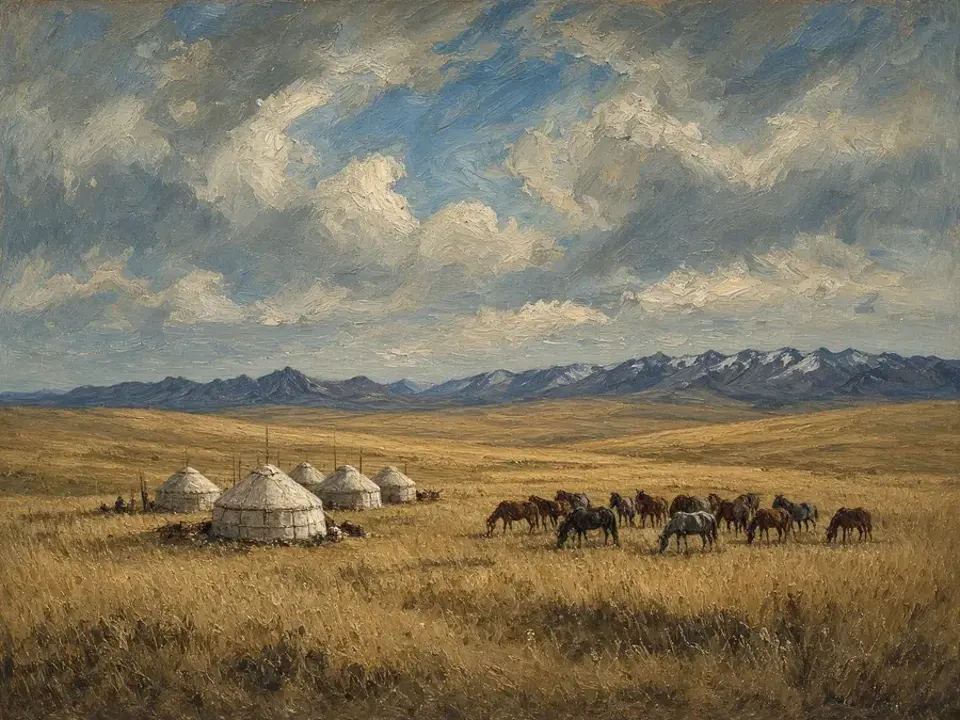
The Eurasian steppe corridor generated distinctive mobility-based polities and cultural repertoires that recurrently transformed agrarian cores across Afro-Eurasia.
The framework read
The author's reading of this civilization.
- Geographic core: steppe corridor from Pontic–Caspian to Mongolia enabling large-scale mobility.
- Cultural-linguistic cohesion: shared nomadic institutional repertoires and steppe diplomatic-military systems.
- Political-economy: tribute, trade control, and confederation/imperial structures integrated with agrarian peripheries.
- Continuity: recurrent formations (Xiongnu, Türk, Mongol, later successor polities) with recognizable civilizational patterns.
Why it works — and how it breaks
- Success vector: G (mobility, cavalry, logistics) + S (pragmatic administration, confederation structures) → enables conquest and tribute extraction.
- Failure modes: S fragmentation (succession disputes, confederation breakdown) + G tech lag (gunpowder shifts advantage) → assimilation into agrarian cores or transformation into successor states (see comparison-turko-persian-synthesis).
By the numbers †
- GDPpeak ~$1.8 billion in 1300 CE, ~1% of world GDP, very low due to low population density, mobility-based economy, tribute extraction
- Population2-4 million, very low density 0.5-1.5/km², mobility-based organization
- Urbanization2-12% urban population, very low urbanization, largest city: Karakorum 50K-80K in 1300 CE, mobility-based organization
- Fiscal Capacitytax revenue: $0.04B-$0.14B, tax-to-GDP ratio: ~8% includes tribute, military spending: 40-50% of tax revenue, tribute-based fiscal systems, mobility-based organization, different fiscal mode
- Technology Index38→44, moderate level, mobility-based adaptations - lower agricultural 7/20, higher military 11/20, cavalry excellence, Silk Road integration, innovation rate 2-5 per century
- Institutional Metrics3-6 officials per 10K, 55% tax efficiency, 50-150 legal provisions, low-moderate, mobility-based, tribute-based systems, lowest globally
- Demographic Structure39-40% under 15, 25-32 years life expectancy, 5-6 fertility, 36-43 mortality, very high youth proportion highest globally, mobility-based, very high mortality
- Infrastructure15,000-25,000 km trade route roads, 500-1,000 km canals, 100 fortifications, 60 bridges, 58/100 sophistication index, Silk Road routes, mobility-based organization limits infrastructure, low
† Scholarly estimates.
People over time
Population (millions) †
† Scholarly estimates, drawn as separately published segments.
Economy
† Estimates after Maddison, to 1945, log scale.
Polities as spans
Each bar opens its entry.
People
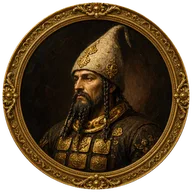
- Genghis Khan1162-1227
Also in the chronicle
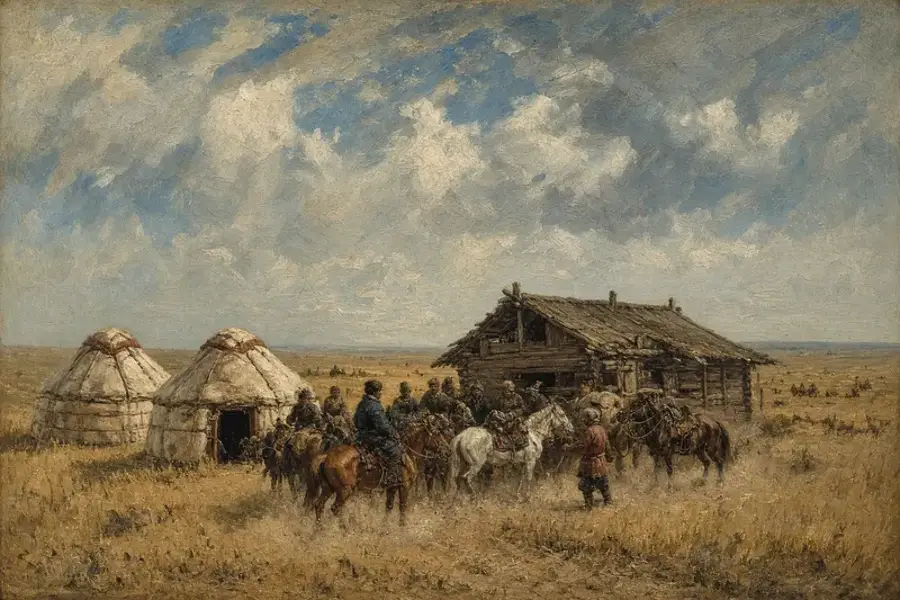
AI-made chronicle art; not evidence.
Patterns and comparisons
Ideas that help read this civilization alongside others.
- Islamic Scholarly Networks and Knowledge TransmissionPattern · Islamic civilization's scholarly networks (madrasas, scholarly travel, translation movements) enabled knowledg
- Steppe Military Organization and Mobile PolitiesPattern · Steppe military organization (cavalry, mobility, logistics, confederation structures) enabled conquest and tri
- Succession Systems Across CivilizationsComparison · Compares succession systems (primogeniture, designated, elective, bureaucratic) across civilizations to identi
- World Ledger — GGS Mappings by CivilizationComparison · Compact mapping of major civilizations' success vectors and failure modes using Guns–Germs–Style; highlights r
Explore this civilization
Polities
Data cards
- Steppe/Central Eurasian Civilization Fiscal Data 500 BCE-1500 CE
- Steppe/Central Eurasian Civilization GDP Data 500 BCE-1500 CE
- Steppe/Central Eurasian Civilization Military Size Data 500 BCE-1500 CE
- Steppe/Central Eurasian Civilization Population Data 500 BCE-1500 CE
- Steppe/Central Eurasian Demographic Structure 500 BCE-1500 CE
- Steppe/Central Eurasian Fiscal Data (1945-present CE)
- Steppe/Central Eurasian GDP Data (1945-present CE)
- Steppe/Central Eurasian Infrastructure Data (1945-present CE)
- Steppe/Central Eurasian Infrastructure Data 500 BCE-1500 CE
- Steppe/Central Eurasian Institutional Metrics 500 BCE-1500 CE
- Steppe/Central Eurasian Military Data (1945-present CE)
- Steppe/Central Eurasian Population Data (1945-present CE)
- Steppe/Central Eurasian Technology Index 500 BCE-1500 CE
- Steppe/Central Eurasian Trade Volume Data 500 BCE-1500 CE
- Steppe/Central Eurasian Urbanization Data (1945-present CE)
- Steppe/Central Eurasian Urbanization Data 500 BCE-1500 CE
People
Events
Conflicts in this civilization
Each conflict opens on its polity page. Evidence badges show how well each is sourced; stub-only conflicts carry no figures.
- 134/133 BCE Han-Xiongnu Wars (134/133 BCE) war series Primary text read
- 1211 CE-1234 CE Mongol Conquest of the Jin Dynasty (1211-1234 CE) conquest Primary text read
- 11 February 1235-19 March 1279 Mongol Conquest of the Song Dynasty (1235-1279 CE) conquest Primary text read
- January-February 1258 (13 days of siege) Siege of Baghdad (1258 CE) siege Stub only
- 3 September 1260 Battle of Ain Jalut (1260 CE) battle Primary text read
Art: Patterns of Civilization chronicle art, made with AI: illustrations, not historical evidence. Entries are drafts preserved from civilization.study. Method and sources.