
 Vesica PiscisSacred geometry
Read the study
Two circles overlap. Their separation changes the shape of the shared region between them.
Try this: Bring the circles closer, then move them apart.
Mathematics · Art · Code
A circle becomes a flower. A rhythm becomes a curve.
Choose a pattern, change one thing, and look again.
Sacred geometry
Still illustration. Every study can be read below without JavaScript.
Follow your curiosity
Explore a mathematical construction, a numerical model, or a clearly labelled interpretation.
Vesica PiscisSacred geometryTwo circles overlap. Their separation changes the shape of the shared region between them.
Try this: Bring the circles closer, then move them apart.
 Star PolygonSacred geometry
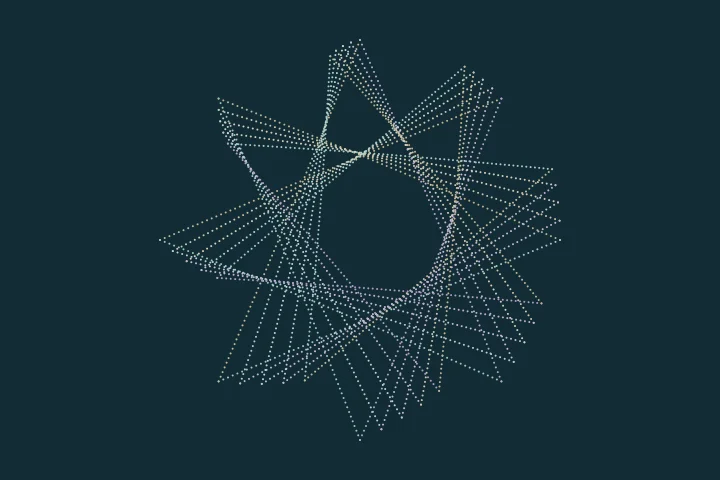
A fixed step connects points around a circle. Changing that step reveals different stars and, sometimes, separate loops.
Try this: Change the number of points before changing the connection step.
 DharmachakraSacred geometry
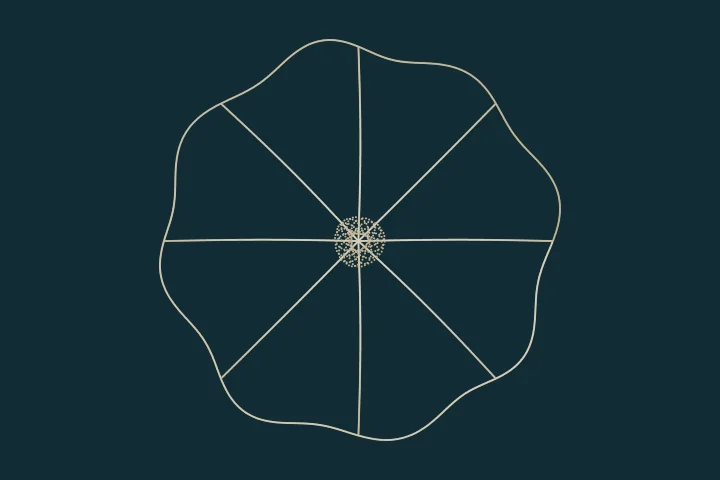
A radial study inspired by the wheel of Dharma. Spokes, rim and centre provide three ways to organise the drawing.
Try this: Change the spokes and look at the spaces between them.
 TaijituSacred geometry
A circular study inspired by the taijitu, with complementary regions and smaller forms nested within them. Its depth is an artistic variation.
Try this: Add a little 3D depth, then return it to zero and compare the flat drawing.
 Sri Yantra-inspired trianglesSacred geometry
Nine layered triangles, four pointing one way and five the other. This is an interpretation inspired by Sri Yantra, not its exact traditional construction.
Try this: Change the depth to separate the layers and follow their edges.
 Tree of LifeSacred geometry
A geometric interpretation of the Kabbalistic Tree of Life. Nodes and paths suggest its structure without replacing an account of the tradition.
Try this: Set motion on and follow the artistic wave along a path.
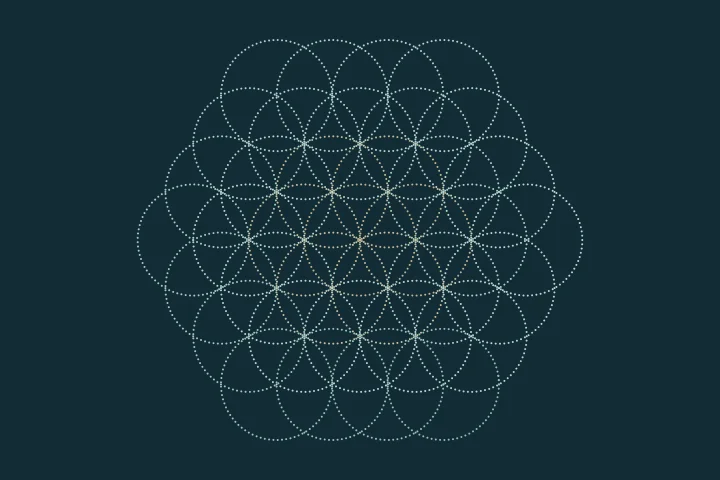
Flower of LifeSacred geometryCircles share their centres on a hexagonal lattice. Each generation extends the repeating arrangement outwards.
Try this: Begin with one generation, then build the pattern a ring at a time.
 Girih-inspired star ornamentSacred geometry
Separate star polygons are arranged in rings, drawing on geometric ornament. This is not a plane tiling or a historical reconstruction.
Try this: Change Star points and compare the spaces between the stars.
 PhyllotaxisSacred geometry
Points step around a centre by a constant angle. Near the golden angle, spirals emerge in more than one direction.
Try this: Nudge the divergence angle and watch the spiral families change.
 Metatron-inspired circle networkSacred geometry
Thirteen circles and a selected connection network form a geometric interpretation. The drawing does not claim every traditional edge or a complete 78-edge graph.
Try this: Turn the form, then return to the front to compare its symmetries.
 Golden-triangle subdivisionMathematical
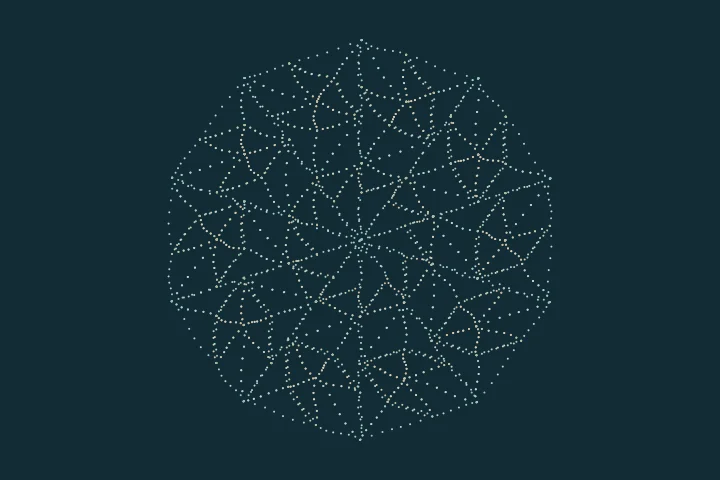
A finite patch is subdivided using the golden ratio. This drawing does not establish Penrose matching rules or an infinite aperiodic tiling.
Try this: Increase Subdivisions and follow a smaller triangle within a larger one.
 Lissajous space curveMathematical
Three repeating motions trace a curve through space. It can cross itself. This is distinct from Ledger’s two-dimensional 3:2 drawing.
Try this: Keep the frequencies fixed and change Relative timing. Turn the view to follow the curve.
 Mandelbrot orbit samplesMathematical
At zero C-offset, parameters c sample the boundaries of the main cardioid and period-two bulb. C-offset shifts those samples away from these boundaries. Iterate z → z² + c from z=0; height records the iteration and escaped points are omitted.
Try this: Change Maximum iterations and compare how far the orbit samples develop.
 Klein bottle immersionMathematical
A figure-eight immersion represents a Klein bottle in three dimensions. Its self-intersection is part of this representation.
Try this: Turn the drawing and look for the figure-eight cross-section.
 Hopf projectionMathematical
Fibres of the Hopf map are projected from the unit 3-sphere. A finite window omits points near the projection pole, so some visible fibres are fragments.
Try this: Reduce Fibres to follow a strand, then turn the projection.
 Lorenz trajectoriesPhysics & dynamics
A sampled Lorenz trajectory, computed with a fixed-step fourth-order Runge–Kutta solver. Optional motion turns the completed drawing; it does not advance physical time.
Try this: Change Rho, then compare the shape. Some parameters settle towards a fixed point.
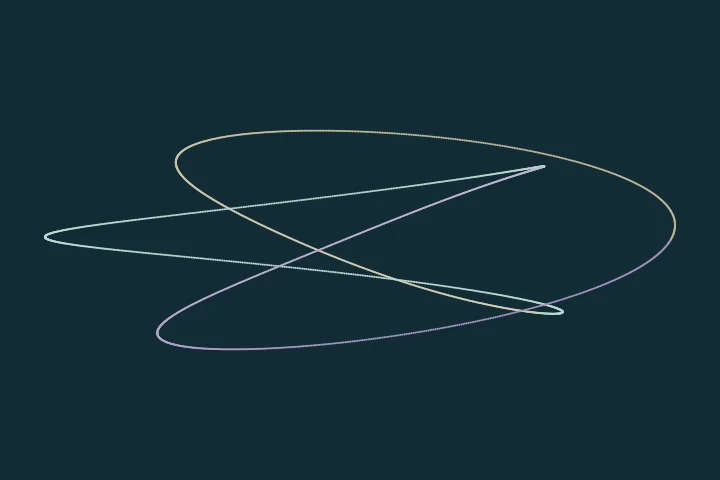 Toroidal curvePhysics & dynamics
A closed curve winds around a ring. Coprime winding counts give a torus knot; shared factors retrace a simpler curve.
Try this: Change one winding count and follow the resulting curve.
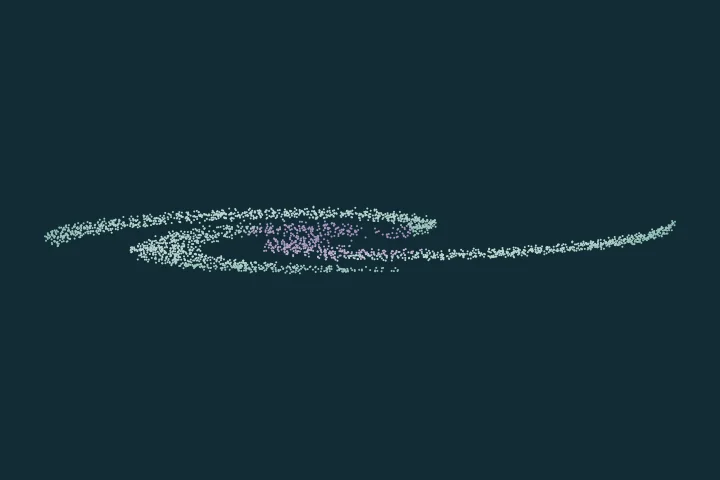 Spiral GalaxyPhysics & dynamics
A stylised spiral galaxy made from points. This is an illustration of structure, rather than an astronomical simulation.
Try this: Change the arm count and notice how the centre stays shared.
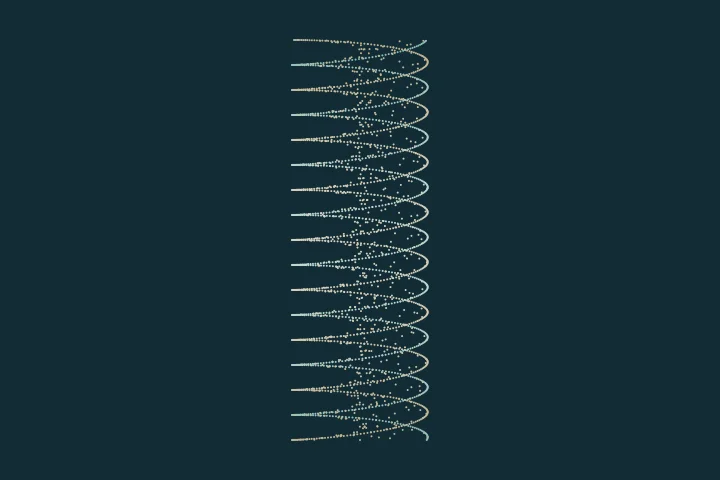 DNA HelixPhysics & dynamics
Two winding strands give a double helix its recognisable form. The drawing simplifies molecular structure.
Try this: Change the twist and watch the relationship between the strands.
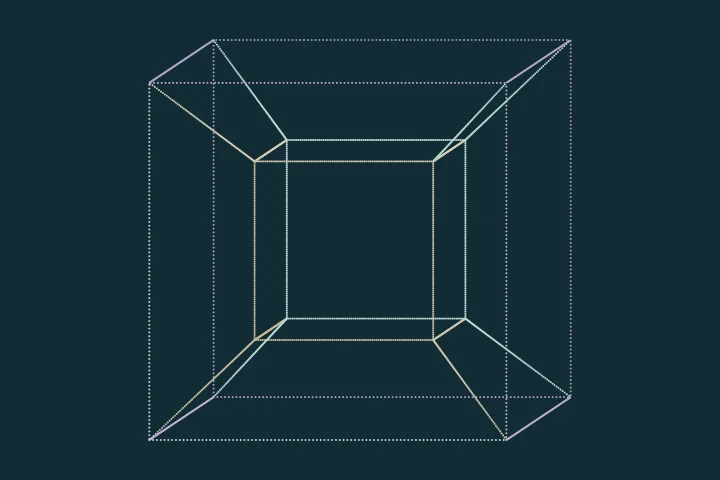 4D TesseractPhysics & dynamics
A projection brings a four-dimensional cube into a three-dimensional view. Some apparent crossings belong to the projection.
Try this: Set it in motion and watch the inner and outer forms exchange places.
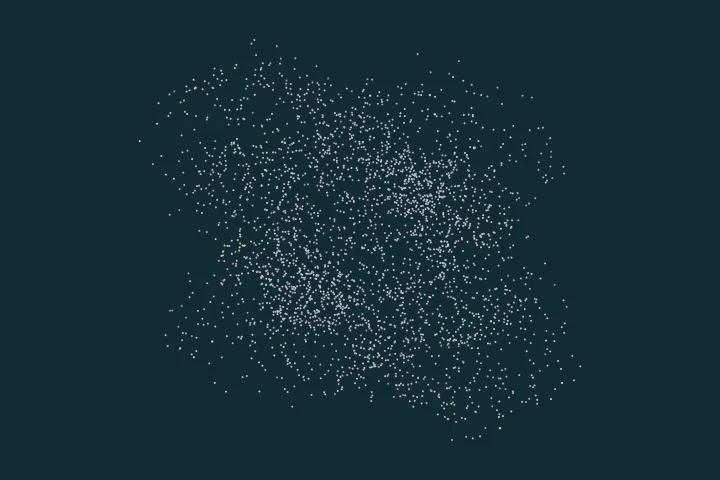 Trigonometric flowPhysics & dynamics
Sine and cosine displacements bend a point cloud. This is procedural art, not a curl field or a fluid simulation.
Try this: Set the drawing in motion and change Displacement strength.
 Sierpinski tetrahedral studyPhysics & dynamics
A finite chaos game repeatedly moves points halfway towards a tetrahedron’s vertices. Motion rotates the cached result.
Try this: Change Chaos steps and compare how clearly the smaller gaps emerge.
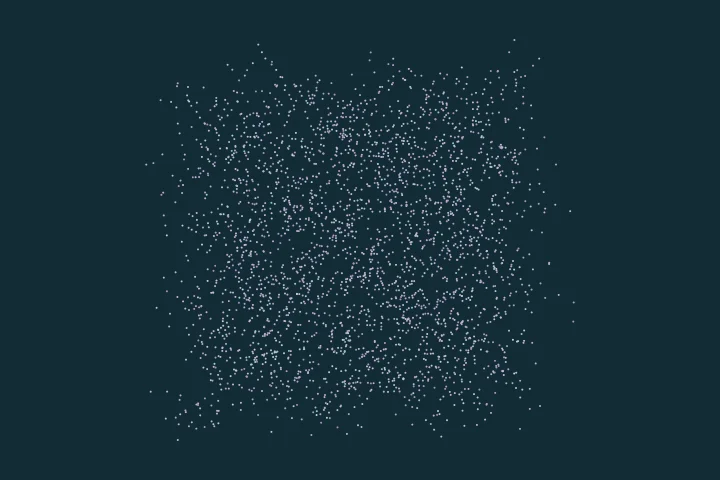 Cosmic web illustrationPhysics & dynamics
A warped point cloud suggests cosmic structure. It contains no observed data or explicit cosmological filament model.
Try this: Change Spatial frequency and compare the concentration of points.
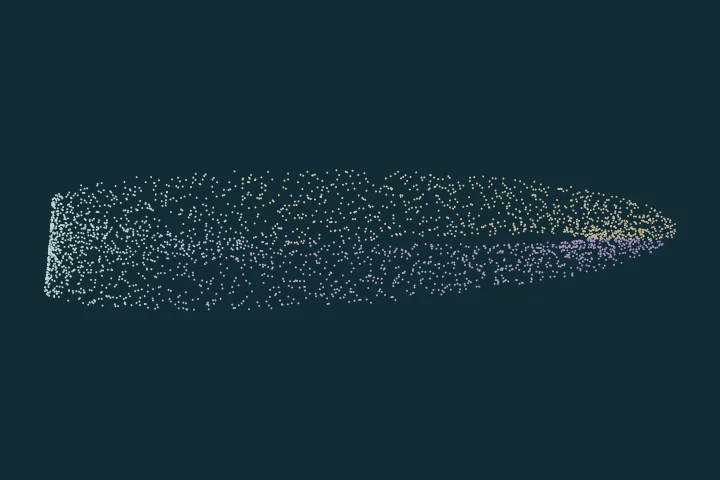 Mobius StripPhysics & dynamics
A strip returns to its starting place with a twist. The familiar single half-twist gives a Möbius strip one continuous side.
Try this: Turn the drawing to follow the strip around its edge.
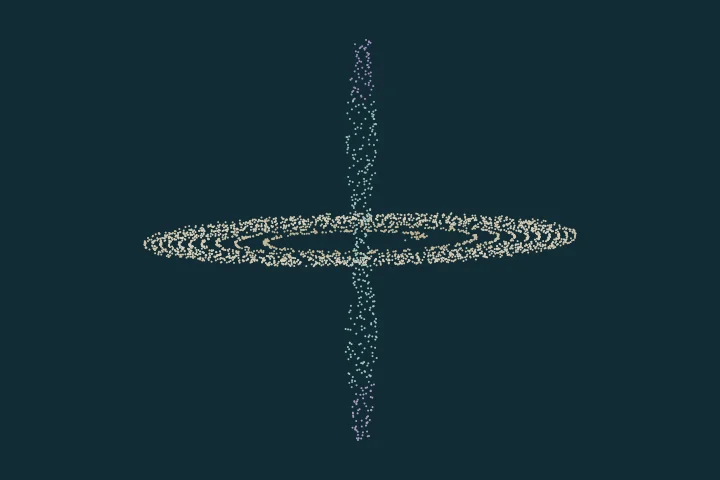 Black HolePhysics & dynamics
An illustrative accretion disc and jets surround a dark centre. Colour and motion express the idea rather than a measured physical model.
Try this: Look along the jet, then turn to see the disc.
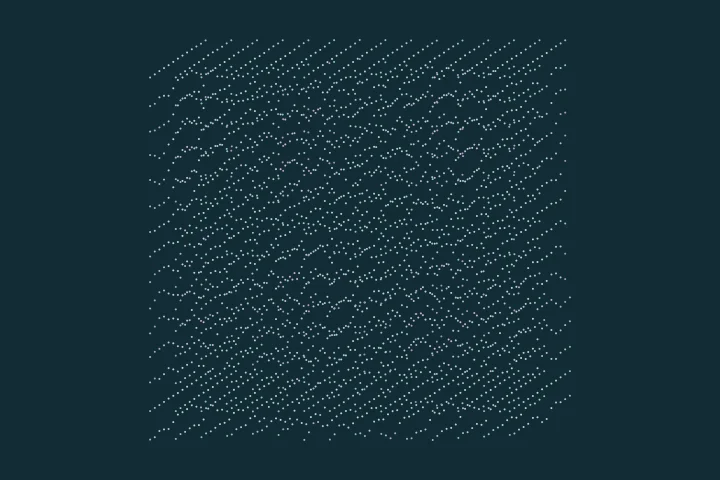 Wave interferencePhysics & dynamics
Several wave terms combine into an interference pattern. This is not a quantum field simulation.
Try this: Change Frequency and look for reinforcement between waves.
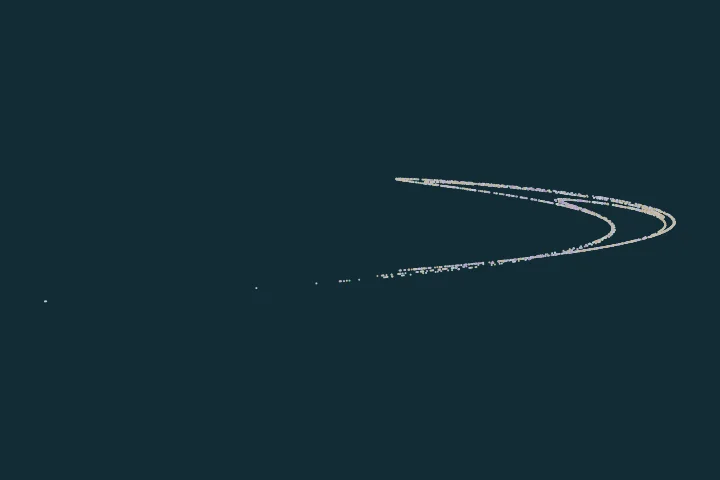 Quadratic map studyPhysics & dynamics
A custom quadratic map is extended into three dimensions. Escaping paths are omitted; some settings leave no bounded result. Chaos is not guaranteed.
Try this: Change Parameter A a little and compare the retained paths.
Look, then read alongside
Adapted from Trivium’s Geometria studies. Credits & licenses.