
case notes
Stephenville: lights, a correction and a radar file
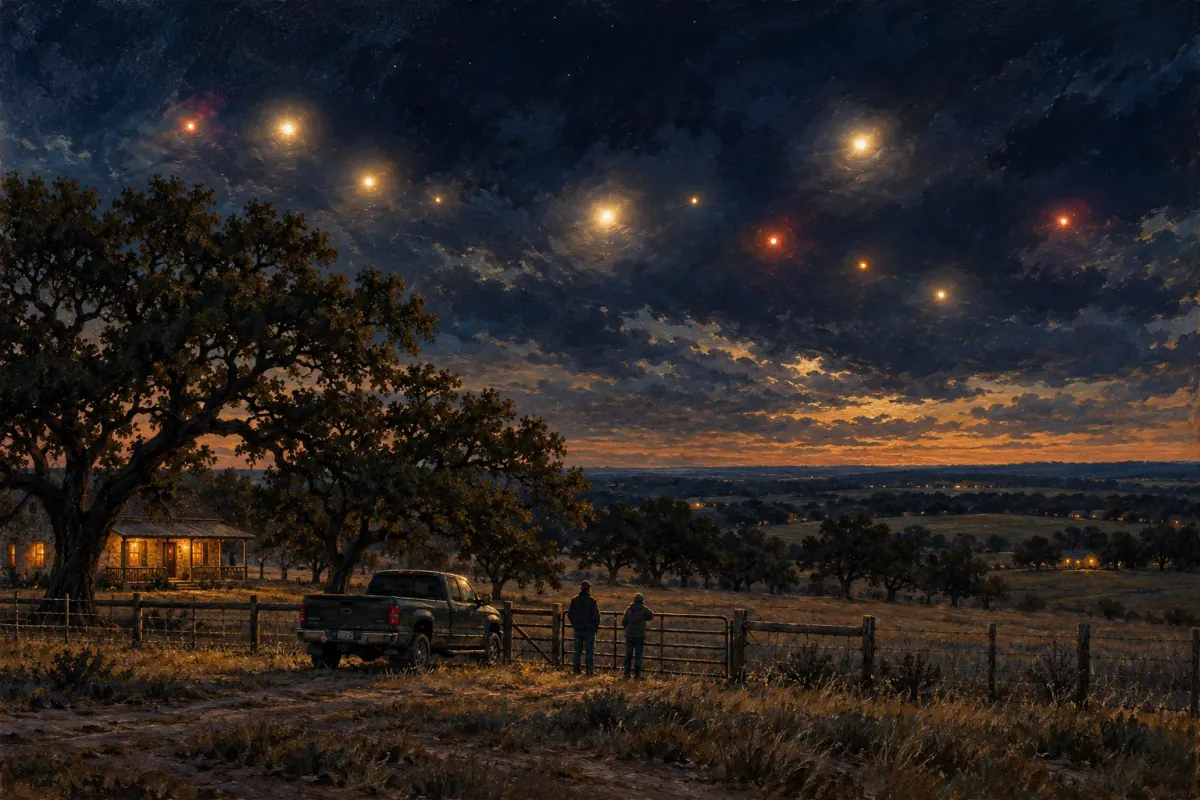
View full artwork →
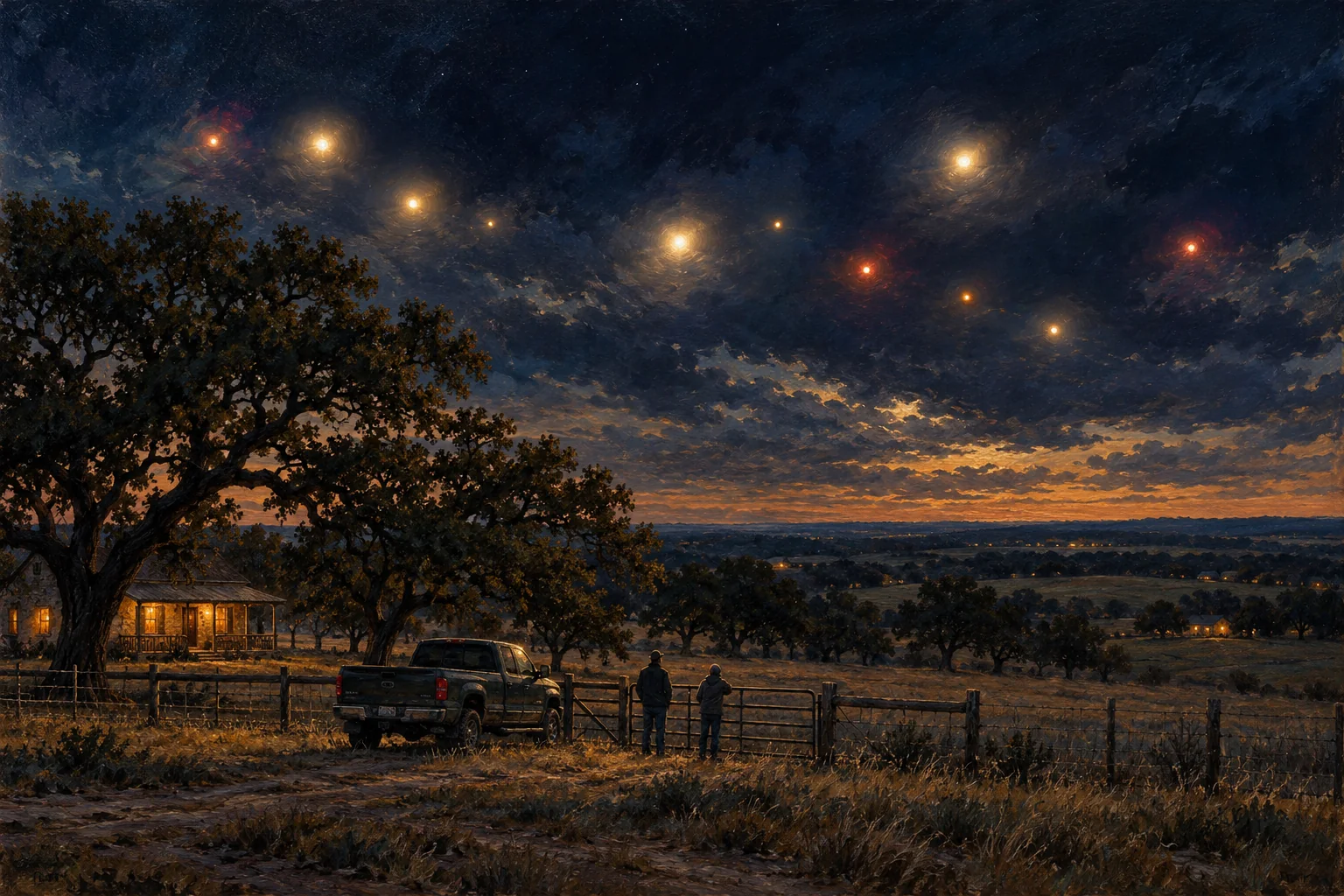
The lights were reported over familiar country: the roads and open land around Stephenville and Dublin, Texas. On the evening of 8 January 2008, observers described something unusual overhead; later, investigators tried to place those accounts alongside the aircraft tracks recorded that night. The story acquired another turn when the Air Force corrected its initial statement about military activity in the area.1
What makes this case absorbing is that the investigation has two clocks. One follows the reported movements of lights and aircraft over a few hours. The other follows the statements, corrections and records released afterwards. Reading both helps separate the night itself from the public argument it became.
Follow the case: the correction · the radar file · read the study and data.
The surviving evidence includes public witness accounts, changing institutional statements and Federal Aviation Administration radar records. They can be compared; they should not be mistaken for three independent confirmations of one unknown object.
Contemporary reporting described a wave of visual accounts across a rural stretch of north-central Texas.1 Some of those accounts came from people used to watching the sky for work. The reports are a public event record. They are not yet a single object with a measured path.
What the Air Force said, and when
Public reporting records two institutional statements. An early public-affairs line from the 301st Fighter Wing said no military aircraft were operating in the area that night. A later correction, widely dated to late January, acknowledged F-16 training activity and described the first denial as an internal communications error.1
The chronology matters more than the embarrassment. An initial denial is a statement about what an office believed or could confirm at the time. A correction establishes that military aircraft were present. It does not, by itself, identify every light that people reported, and it does not automatically explain every radar return later pulled from the FAA files.
Radar as a documentary product
Independent researchers obtained FAA radar text for the evening under the Freedom of Information Act. Public mirrors host those dumps.1 Glen Schulze and Robert Powell later published a long study of the returns together with the witness reports. They argue that some primary-only tracks — returns without a transponder code — do not match the known F-16 and commercial traffic, and they discuss motion toward restricted airspace in the region.2
Those are analysis claims about a public file. Extreme speed figures that appear in later summaries remain estimates attached to that analysis, not measurements we can repeat from the clip of a story. Other readings treat some of the same primary returns as clutter, processing artifacts or an incomplete request window.
A military-aircraft explanation is specific enough to test against some of the visual reports. A claim that unknown tracks remain after that accounting needs the radar file, the study’s method and a chance for someone else to disagree. Failure to explain one observation does not supply the other kind of proof.
Read the study and data
The Schulze–Powell repository places the study beside the underlying FAA text files. That is an invitation to check the proposed matches, not simply accept the conclusions. Begin with the study’s sequence of observations, then ask how a particular radar return was associated with a particular account. A primary return without an identifying transponder code is a detection requiring interpretation; it is not already the identity of an unusual aircraft.
The Belgian wave also gathers many accounts under one famous name and then has to separate them again. Washington in 1952 is an earlier radar-visual wave with an official weather reading. The habit is the same: say which part of the night a piece of evidence actually belongs to.
Footnotes
-
The Black Vault, “UFO Case: Stephenville, Texas — January 08, 2008”, with a document mirror of the FAA radar releases. A public archive of press, statements and FOIA radar text, not an identification of the lights. ↩ ↩2 ↩3 ↩4
-
Glen Schulze and Robert Powell, Stephenville Lights: A Comprehensive Radar and Witness Report Study, Zenodo record 10530422; also circulated via SCU and a NICAP PDF mirror. An independent reading of the FAA file, not an official finding. ↩