essay
The Master Mason: Integrity and Legacy
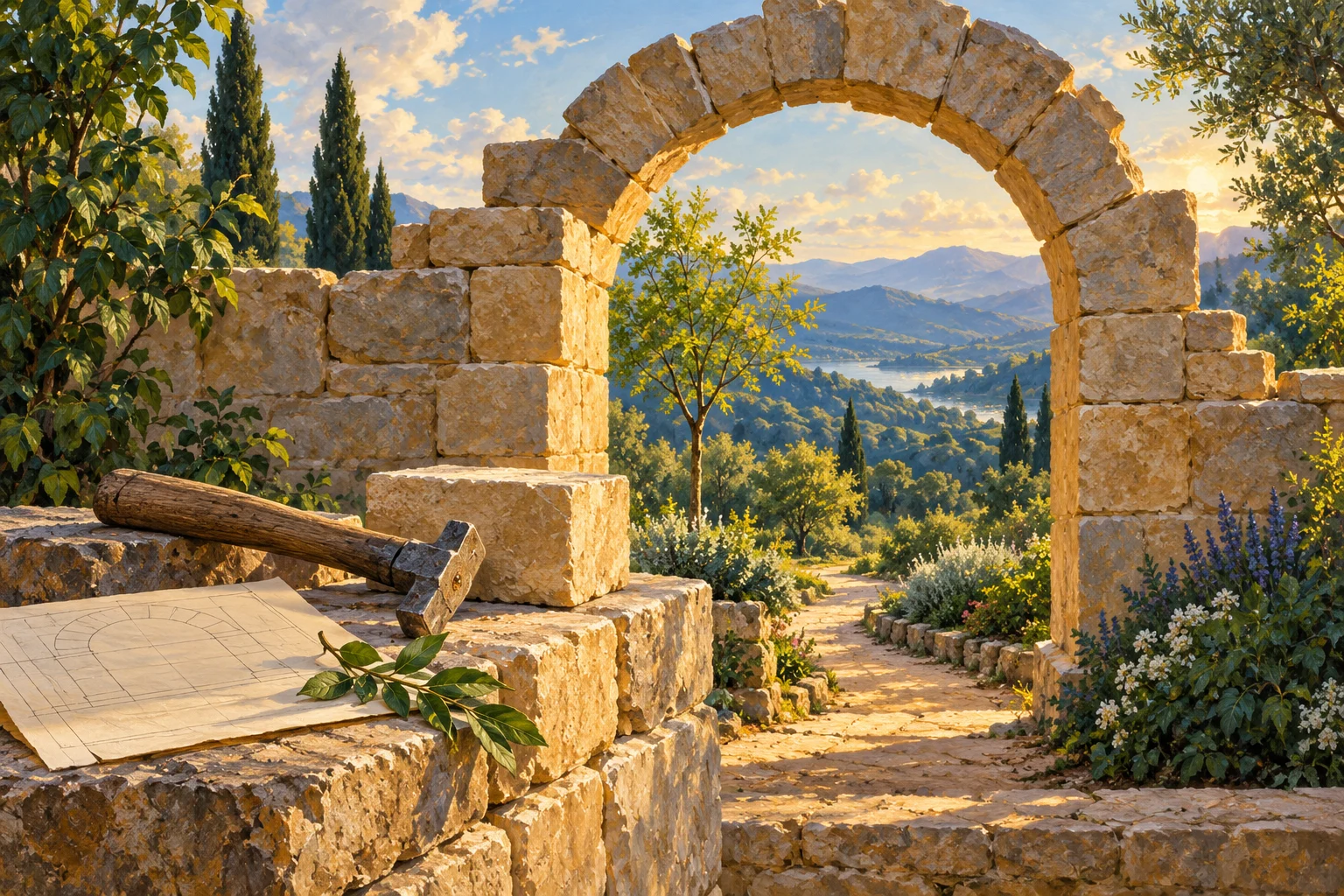
View full artwork →
A well-made tool can pass through several hands. The person who first taught someone to use it may be gone, while something of that teaching survives in the way the next person works.
That is where I begin with the third degree. The Apprentice learns to receive instruction. The Fellowcraft develops the skill to make a useful contribution. The Master Mason must consider what he is responsible for, what he cannot control, and what another person may one day have to carry.
Mortality gives these questions their urgency. In the public teaching of the Grand Lodge of Canada in the Province of Ontario, the third degree places the certainty of death beside a spiritual hope that reaches beyond it.1 I find both necessary. Death makes our time precious; hope allows us to spend it on something beyond ourselves.
Integrity when it costs something
Hiram Abiff, the master builder of Masonic legend, brings integrity into focus. In a public address, William R. Cave, then Grand Master of British Columbia and Yukon, reads the legend through fidelity, the brevity of life, and the example of a builder who teaches others.2 It is an allegory I return to because it asks what happens to a commitment when keeping it becomes difficult.
Most of us encounter that question without a dramatic ordeal. We find an error that makes our work look better than it is. Someone less powerful could conveniently take the blame. A promise made in enthusiasm becomes inconvenient to honour.
At such moments, integrity becomes a cost we either accept or pass to somebody else.
I understand it as an effort to remain whole: to let the principles I profess govern the decisions that other people may never see. This requires judgement as well as resolve. A mistaken belief should be corrected. A harmful course should be changed. Fidelity to what is right sometimes means admitting that I have been wrong.
The useful question is therefore more demanding than whether I can stand firm. Can I distinguish a principle worth defending from a position I am merely reluctant to surrender? Can I tell the truth when it changes how people see me?
The degree does not settle those questions for me. It makes it harder to pretend they are someone else’s work.
What knowledge cannot spare us
There is a difference between understanding a description and living through the thing described. Advice can help a new parent, but it cannot perform the daily responsibility of caring for a child. An account of grief can prepare us to listen; it cannot contain the loss of a particular person.
The original attraction of the third degree, for me, was its recognition of this limit. More information does not place every experience within our command. We can become highly capable and still need someone to sit beside us when there is nothing useful left to explain.
I do not think suffering has to be earned, or that it reliably makes anyone wiser. Its demands are uneven, and much of it is simply painful. What matters is how we accompany one another through what cannot be mastered by technique.
This changes my picture of maturity. Competence includes knowing when I can help. It also includes recognising when I need help, and allowing another person to give it.
Three tools, and the limits of ambition
Ontario’s public account names three Master Mason’s tools: the skirret, the pencil and the compasses.3
The skirret provides a line for marking out the ground. The manual describes a straight chalk line and connects it with conduct guided by the Volume of the Sacred Law. I read that as a question about direction: before becoming more effective, have I considered where this effort is taking me?
The pencil records a design before it becomes a structure. Its moral association in the manual is accountability before God for our words and actions. Intention matters, but I am also answerable for what I actually put into the world, including consequences I would rather overlook.
The compasses concern proportion and limits. The manual connects them with restraining our passions and desires. For me, this is a needed correction to ambition. The ability to undertake something does not establish that it deserves all the time, money or attention I can give it.
Together, these tools suggest a form of responsibility that grows with our freedom to act. The person drawing the plan must consider who will live with it.
A project can be admirable and still consume too much of a life. There are people to be present for, promises already made, and ordinary duties that will never compete successfully with a more exciting idea. Learning to stop, decline or finish can be as important as learning to begin.
Leaving work that others can carry
The cathedral image still matters to me: a builder setting a stone in a structure he will never see completed. It gives shape to the willingness to contribute beyond the horizon of personal reward.
But legacy becomes too grand if it requires a cathedral. It is present in a skill patiently taught, a family story recorded while someone can still tell it, or a responsibility handed over with enough care that the next person can succeed.
Consider a volunteer who has kept a small community organisation running for years. He knows every supplier and remembers why each arrangement exists. If all of that remains in his head, his dedication has also created a vulnerability. Part of his next contribution is to teach another person, explain the awkward details and let them practise while he is still there to help.
That can be harder than doing the work himself. It asks him to tolerate a different approach and to accept that being needed is not the only evidence that he matters.
Ontario’s mentoring material places responsibility for others, teaching and care for younger brethren within the Master Mason’s obligations.4 I see a demanding kindness in this. Help someone become capable enough to continue without you; leave them the freedom to improve what you have done.
There is no guarantee that our projects will survive, or that successors will make the choices we would have made. The value of care cannot depend entirely on that outcome. A shelter that later closes may still have sheltered someone. A lesson that is eventually forgotten may still have helped its learner through a difficult year.
We should try to leave sound work. We should also recognise the good it can do before it disappears.
Brotherhood, faith and unfinished work
The same Ontario mentor programme reminds the new Master Mason that learning continues and that sponsors, officers and brethren remain available for advice and encouragement.4 Responsibility grows within fellowship. Nobody has to pretend that receiving a title has made him sufficient unto himself.
This matters especially when illness, age or grief reduces what a person can do. Brotherhood must reach the man whose useful labour has ceased. Otherwise, the language of service becomes another way of valuing people only for their output.
My Christian faith carries this further. I place my hope in God, not in the permanence of anything I make. Resurrection is part of that hope; a surviving name or institution cannot substitute for it. This is the faith I bring to these symbols, among brethren whose religious convictions differ from mine.
It leaves me with a different understanding of legacy. I want to build things worth keeping, but I also want to love people without turning them into evidence that my life was productive. Some of the most important service may leave no visible monument: keeping company with someone who is frightened, forgiving an injury, or returning when help is still needed.
The three degrees form a coherent movement in my mind. Humility makes room for instruction. Practice makes that instruction useful. Integrity governs the use of growing ability, while mortality reminds us that our part in the work is finite.
The third degree completes this sequence without completing the person. I still need the Apprentice’s willingness to be corrected and the Fellowcraft’s patience with difficult work. What changes is the horizon. Alongside the question of what I can make comes the question of what I can faithfully entrust to someone else.
The first stone gives the next one somewhere sound to rest. In time, another pair of hands must be free to place it.
Third and final essay in Initiation & Transformation: From Apprentice to Architect. Begin with The Entered Apprentice, or return to The Fellowcraft.
Footnotes
-
Grand Lodge A.F. & A.M. of Canada in the Province of Ontario, Lodge Resources Manual, March 2009, §2.4.6, p. FTF16: its public introduction places the third degree’s contemplation of death alongside spiritual immortality and hope. Public copy hosted by Zetland Wilson Lodge No. 86. ↩
-
William R. Cave, “Be a Builder,” Grand Master’s Installation Address, 18 June 2011. This public interpretation comes from British Columbia and Yukon, rather than Ontario, and describes Hiram as a figure of legend. ↩
-
Grand Lodge of Canada in the Province of Ontario, Lodge Resources Manual, March 2009, §21.3, p. OGL7. The personal applications here develop its public account of the tools. ↩
-
Grand Lodge of Canada in the Province of Ontario, Lodge Resources Manual, March 2009, §3.13, pp. M23–25. ↩ ↩2