
Work / Civilization / Civilizations / Mesoamerican
Mesoamerican
Mesoamerica developed enduring urban, calendrical, and ritual-institutional complexes across multiple polities with recognizable civilizational continuities.
The framework read
The author's reading of this civilization.
- Geographic core: highland–lowland nodes from Oaxaca and the Valley of Mexico to Maya regions.
- Cultural-linguistic cohesion: writing/calendrical systems and shared ritual-architectural repertoires across polities.
- Political-economy: tribute, market exchange, and ritual centers linking urban and rural zones.
- Continuity: civilizational frames persist across Olmec, Maya, Teotihuacan, Toltec, and Mexica phases.
Why it works — and how it breaks
- Success vector: S (ritual-infrastructure coordination, calendrical systems enabling agricultural planning) + G (organized defense, tribute extraction).
- Failure modes: S fragmentation (city-state competition, elite conflict) + B disease catastrophe at contact (Columbian Exchange) → rapid collapse; internal breakdown in some cases (Teotihuacan).
By the numbers †
- GDPpeak ~$4.3 billion in 900 CE, ~3-4% of world GDP, decline 900-1200 CE linked to Classic collapse, recovery 1200-1500 CE
- Population5-15 million, peak ~12 million in 900 CE, decline 900-1200 CE linked to Classic collapse, recovery 1200-1500 CE
- Urbanization25-30% urban population, high urbanization, largest city: Tenochtitlan 200K-300K in 1500 CE, temple-palace cities
- Fiscal Capacitytax revenue: $0.14B-$0.43B, tax-to-GDP ratio: ~8%, military spending: ~50% of tax revenue, tribute-based fiscal systems, temple-state coordination
- Technology Index42→48, moderate level, isolation impact - low diffusion rate, limited metallurgy 7/20, high knowledge technology 12/20 - writing, mathematics, astronomy, calendrical systems
- Institutional Metrics6-10 officials per 10K, 60% tax efficiency, 100-200 legal provisions, moderate, tribute-based systems, isolation impact
- Demographic Structure35-39% under 15, 28-37 years life expectancy, 5-6 fertility, 32-43 mortality, growth/decline/recovery, Classic collapse linked to demographic crisis
- Infrastructure5,000-8,000 km sacbeob roads, 2,000-4,000 km canals, 200 fortifications, 150 bridges, chinampas, 68/100 sophistication index, sacbeob network, chinampas, isolation impact, Style axis support
† Scholarly estimates.
People over time
Population (millions) †
† Scholarly estimates, drawn as separately published segments.
Economy
† Estimates after Maddison, to 1945, log scale.
Polities as spans
Each bar opens its entry.
Turning points
- c. 800–950 CEClassic Maya collapse
- 1492 CEColumbus Reaches Americas
- 1521 CESpanish Conquest of Tenochtitlan
- 1521 CEFall of Tenochtitlan
People
- K'inich Janaab' Pakal I603–683 CE
Also in the chronicle
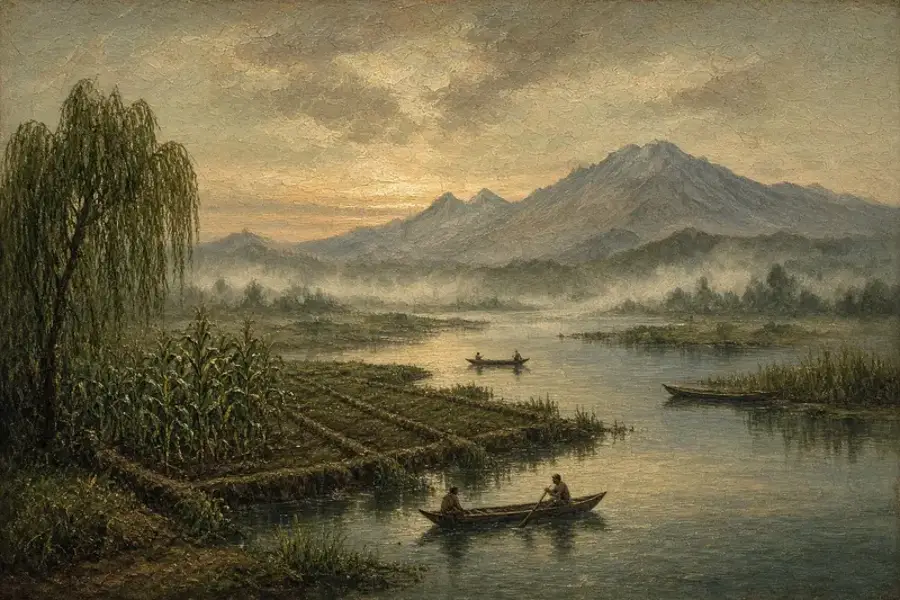
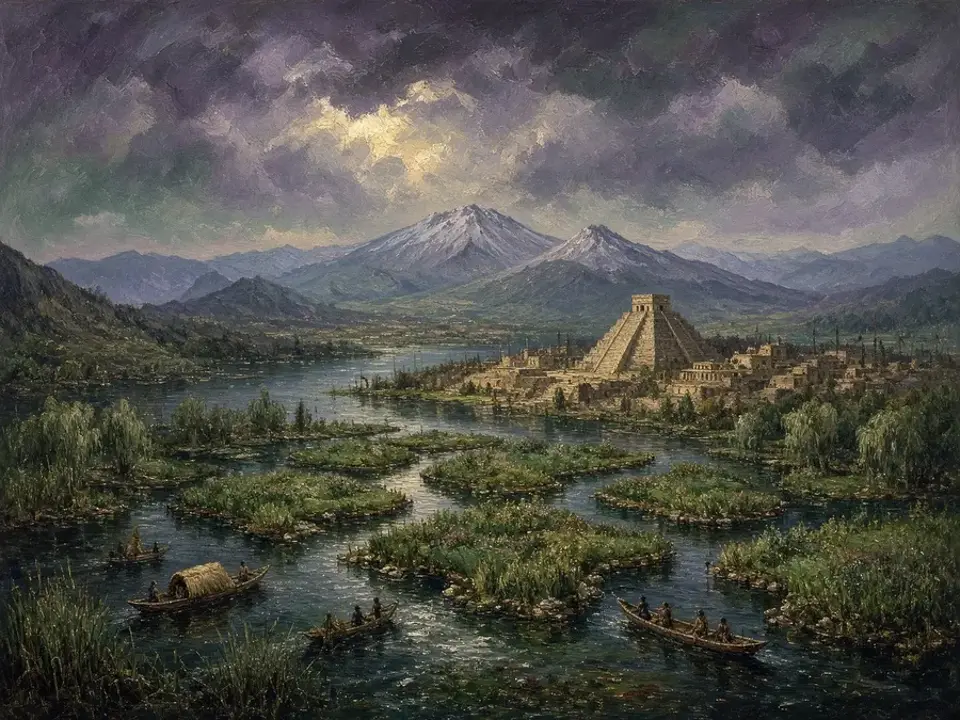
AI-made chronicle art; not evidence.
Patterns and comparisons
Ideas that help read this civilization alongside others.
- Mesoamerican Tribute Systems and Economic CoordinationPattern · Mesoamerican tribute systems (goods, labor, military service) enabled economic coordination and state capacity
- World Ledger — GGS Mappings by CivilizationComparison · Compact mapping of major civilizations' success vectors and failure modes using Guns–Germs–Style; highlights r
Explore this civilization
Data cards
- Mesoamerican Civilization Fiscal Data 500-1500 CE
- Mesoamerican Civilization GDP Data 500-1500 CE
- Mesoamerican Civilization Military Size Data 500-1500 CE
- Mesoamerican Civilization Population Data 500-1500 CE
- Mesoamerican Civilization Urbanization Data 500-1500 CE
- Mesoamerican Demographic Structure 500-1500 CE
- Mesoamerican GDP Data (1945-present CE)
- Mesoamerican Infrastructure Data 500-1500 CE
- Mesoamerican Institutional Metrics 500-1500 CE
- Mesoamerican Military Data (1945-present CE)
- Mesoamerican Population Data (1945-present CE)
- Mesoamerican Technology Index 500-1500 CE
Concepts
People
Events
Comparisons
Conflicts in this civilization
Each conflict opens on its polity page. Evidence badges show how well each is sourced; stub-only conflicts carry no figures.
- 537 CE-838 CE (per Wikipedia infobox, Long-Count based) Tikal-Calakmul Wars (c.537-838 CE) war series Stub only
- c.1427 CE-1428 CE (conventional; not extracted from a source) Tepanec War and Formation of the Triple Alliance (c.1427-1428 CE, conventional) war Primary text read
- 1454 CE-1519 CE (per Wikipedia infobox) Flower Wars (Xochiyaoyotl) (c.1454-1519 CE) war series Primary text read
- February 1519-13 August 1521 Spanish Conquest of the Aztec Empire (1519-1521 CE) conquest Primary text read
- 7 July 1520 Battle of Otumba (1520 CE) battle Primary text read
- 30 June-1 July 1520 La Noche Triste (1520 CE) battle Primary text read
Art: Patterns of Civilization chronicle art, made with AI: illustrations, not historical evidence. Entries are drafts preserved from civilization.study. Method and sources.