
Work / Civilization / Civilizations / Sinitic / East Asian

Sinitic / East Asian
East Asia centered on the Yellow and Yangtze basins forms a Sinitic civilization with enduring cultural-linguistic and institutional continuity.
The framework read
The author's reading of this civilization.
- Geography: Yellow/Yangtze basins as agricultural and administrative core, later maritime extensions.
- Cultural-linguistic cohesion: Classical Chinese script and literary canon sustaining elite culture across regimes.
- Political-economy: recurrent imperial bureaucracies with taxation and examination systems.
- Continuity: dynastic cycles yet persistent civilizational identity recognized internally and externally.
Why it works — and how it breaks
- Success vector: S (bureaucratic capacity, examination systems, Neo-Confucian legitimacy) + G (organized defense, frontier management).
- Failure modes: S capture (elite competition, dynastic cycles) + G frontier pressure (steppe confederations, later gunpowder/industrial rivals) + periphery upshift (see concept-periphery-upshift); resets via dynastic transitions and institutional reforms.
By the numbers †
- GDPlargest global economy, ~22-25% of world GDP
- Populationlargest global population, ~21-23% of world population, high density 25-30/km²
- Urbanization20-25% urban population, largest cities globally: Kaifeng/Hangzhou 1.0-1.5M, highest urbanization globally
- Fiscal Capacitytax revenue: $2.1B to $6.2B, tax-to-GDP ratio: 8% to 10%, military spending: 36% to 62% of tax revenue, fiscal-military relationship, bureaucratic efficiency
- Technology Index70→72, pre-divergence leadership, relative decline vs Western/Atlantic, innovation rate 6-12 per century, gunpowder/printing innovations
- Institutional Metrics18-25 officials per 10K, 85% tax efficiency, 3,000 legal provisions, highest globally, very high bureaucratic capacity, legal sophistication, educational systems
- Demographic Structure35-38% under 15, 30-37 years life expectancy, 5-6 fertility, 32-40 mortality, balanced structure, high youth proportion
- Infrastructure35,000-40,000 km roads, Grand Canal 1,800+ km, Great Wall 6,000-8,000 km, 500 fortifications, 1,000 bridges, 82/100 sophistication index, exceptional canal systems, Style axis support
† Scholarly estimates.
People over time
Population (millions) †
† Scholarly estimates, drawn as separately published segments.
Economy
† Estimates after Maddison, to 1945, log scale.
Polities as spans
Each bar opens its entry.
Turning points
- 1600 BCEShang Dynasty
- 1046 BCEZhou Dynasty
- 221 BCEQin Unification of China
- 220 CEFall of Han Dynasty
- 618 CETang Dynasty
- 960 CESong Dynasty
- 1347 CEBlack Death
- 1368 CEMing Dynasty
- 1868 CEMeiji Restoration
- 1912 CERepublic of China
People
- The Buddha (Siddhartha Gautama)563-483
- Confucius551-479
- Emperor Wu of Han156-87
- Mencius372-289
- Qin Shihuang (First Emperor of China)259-210
- Sima Qian145-86
- Xunzi310-235
- Zhu Xi1130-1200
Also in the chronicle


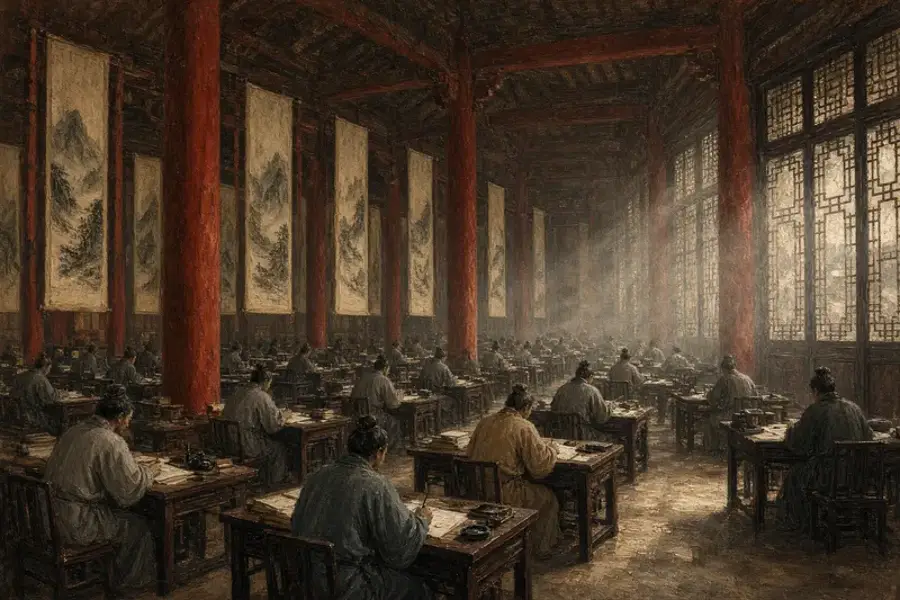
AI-made chronicle art; not evidence.
Patterns and comparisons
Ideas that help read this civilization alongside others.
- Educational Systems and Elite Formation Across CivilizationsComparison · Compares educational systems (Confucian examinations, Islamic madrasas, European universities, monastic school
- Legal Systems Across CivilizationsComparison · Compares legal systems (Roman, Islamic, Chinese, common law) to identify patterns in how law structures govern
- Succession Systems Across CivilizationsComparison · Compares succession systems (primogeniture, designated, elective, bureaucratic) across civilizations to identi
- Sinitic Bureaucratic Examination SystemPattern · Sinitic civilization's examination-based bureaucratic elite formation created distinctive institutional capaci
- Virtue Ethics and Character CultivationPattern · Virtue ethics (character cultivation, moral exemplars, virtue-based selection) shapes elite formation, legitim
- Epistemological Traditions Across CivilizationsComparison · Compares epistemological traditions (how civilizations structure knowledge, truth, and evidence) to identify p
- Moral Philosophy Across CivilizationsComparison · Compares moral philosophy (virtue ethics, duty ethics, rights ethics, religious ethics) across civilizations t
Explore this civilization
Polities
- Champa
- Goguryeo
- Han Dynasty
- Jin Dynasty
- Joseon Dynasty
- Kingdom of Champa
- Kingdom of Goryeo
- Kingdom of Joseon
- Kingdom of Nepal
- Kingdom of Ryukyu
- Kingdom of Tibet
- Liao Dynasty
- Ming Dynasty
- Modern Japan
- People's Republic of China (PRC)
- Qin Dynasty
- Qing Dynasty
- Shang Dynasty
- Silla
- Song Dynasty
- Sui Dynasty
- Tang Dynasty
- Tokugawa Shogunate
- Xiongnu Empire
- Yuan Dynasty
- Zhou Dynasty
- Đại Việt
Data cards
- Modern China GDP Data 1949-present CE
- Sinitic/East Asian Civilization GDP Data 1800-1945 CE
- Sinitic/East Asian Civilization GDP Data 1945-present CE
- Sinitic/East Asian Civilization Military Data 1945-present CE
- Sinitic/East Asian Civilization Population Data 1800-1945 CE
- Sinitic/East Asian Civilization Population Data 1945-present CE
- Sinitic/East Asian Civilization Technology Index 1945-present CE
- Sinitic/East Asian Demographic Structure 1000-1500 CE
- Sinitic/East Asian Demographic Structure Data 1945-present CE
- Sinitic/East Asian Fiscal Capacity Data 1945-present CE
- Sinitic/East Asian Fiscal Data 1000-1500 CE
- Sinitic/East Asian GDP Data 1000-1500 CE
- Sinitic/East Asian Infrastructure Data 1000-1500 CE
- Sinitic/East Asian Infrastructure Data 1945-present CE
- Sinitic/East Asian Institutional Metrics 1000-1500 CE
- Sinitic/East Asian Military Size Data 1000-1500 CE
- Sinitic/East Asian Population Data 1000-1500 CE
- Sinitic/East Asian Technology Index 1000-1500 CE
- Sinitic/East Asian Trade Volume Data 1000-1500 CE
- Sinitic/East Asian Trade Volume Data 1945-present CE
- Sinitic/East Asian Urbanization Data 1000-1500 CE
- Sinitic/East Asian Urbanization Data 1945-present CE
Concepts
- Architectural Iconography and Symbolic Architecture
- Buddhist Persecutions in China (Religion–State Friction)
- Chinese Creation Myths
- Confucian Examination System as Ontological Governance
- Confucianization under Emperor Wu of Han
- Creation Myths and Civilizational Style
- Dharmakīrti and Buddhist Logic
- Dynastic Cycle as Trait–Legitimacy Dynamics
- East Asian Mādhyamaka Adaptations
- Epistemology Systems and Knowledge Structures
- Ethics Systems and Moral Frameworks
- Huang–Lao Statecraft (Han Syncretism)
- Imperial Rescript on Education (1890) — Civil Religion and Pedagogy
- Innovation, Openness, and Control
- Lingua Francas and Administrative Languages
- Madhyamaka (Nāgārjuna) and Trans-Asian Transmission
- Monetary Iconography and Currency Symbols
- Neo-Confucianism (Song–Ming Intellectual Core)
- Political Iconography and Authority Symbols
- Radius of Trust
- Religious Iconography and Sacred Symbols
- Religious Syncretism as Civilizational Boundary Marker
- Ritual Iconography and Ceremonial Symbols
- Song Neo-Confucian Curriculum and Institutions
- Tokugawa Neo-Confucianism
- Translation Systems and Cross-Linguistic Transmission
- Writing Systems as Civilizational Infrastructure
- Śūnyatā (Emptiness) in Buddhist Metaphysics
People
Events
- Black Death (1347 CE)
- Fall of Han Dynasty (220 CE)
- Globalization Acceleration (1990s CE)
- Meiji Restoration (1868 CE)
- Ming Dynasty (1368 CE)
- People's Republic of China Formation (1949 CE)
- Qin Unification of China (221 BCE)
- Republic of China (1912 CE)
- Shang Dynasty (1600 BCE)
- Song Dynasty (960 CE)
- Tang Dynasty (618 CE)
- World War II (1939-1945 CE)
- Zhou Dynasty (1046 BCE)
Comparisons
- Educational Systems and Elite Formation Across Civilizations
- Epistemological Traditions Across Civilizations
- Legal Systems Across Civilizations
- Lingua Francas Across Civilizations
- Moral Philosophy Across Civilizations
- Philosophical Influence Bridges Across Civilizations
- Religious Institutions and Civilizational Cohesion
- Sinic Interactions with Korea, Japan, and Vietnam
- Stoic Logos vs Zhu Xi’s Li (理)
- Succession Systems Across Civilizations
- Syncretic Zones and Frontier Blends
- Translation Traditions Across Civilizations
- World Ledger — GGS Mappings by Civilization
Claims
Conflicts in this civilization
Each conflict opens on its polity page. Evidence badges show how well each is sourced; stub-only conflicts carry no figures.
- 262-260 BCE Battle of Changping (262-260 BCE) battle Primary text read
- 230 BCE-221 BCE Qin's Wars of Unification (230-221 BCE) war series Primary text read
- 134/133 BCE Han-Xiongnu Wars (134/133 BCE) war series Primary text read
- May-September 751 CE Battle of Talas (751 CE) battle Primary text read
- 16 December 755-17 February 763 An Lushan Rebellion (755-763 CE) rebellion Primary text read
- October 763 CE (about 15 days) Tibetan Occupation of Chang'an (763 CE) conquest Primary text read
- 1211 CE-1234 CE Mongol Conquest of the Jin Dynasty (1211-1234 CE) conquest Primary text read
- 11 February 1235-19 March 1279 Mongol Conquest of the Song Dynasty (1235-1279 CE) conquest Primary text read
- 1258, 1283-1285, 1287-1288 Mongol Invasions of Vietnam (1258-1288 CE) war series Primary text read
- 16 October 1268-14 March 1273 Siege of Xiangyang (1268-1273 CE) siege Primary text read
- 19 March 1279 Battle of Yamen (1279 CE) naval battle Primary text read
- 9 April 1288 Battle of Bach Dang (1288 CE) naval battle Primary text read
- 22 January-early August 1293 Mongol (Yuan) Invasion of Java (1293 CE) naval expedition Primary text read
- 1687 CE-1758 CE Dzungar-Qing Wars (1687-1758 CE) war series Primary text read
- 1716–1717 Dzungar Conquest of Tibet (1716–1717) conquest Primary text read
- 1720 CE Qing Expedition to Tibet (1720 CE) expedition Primary text read
- 4 September 1839-29 August 1842 First Opium War (1839-1842 CE) interstate war Primary text read
- December 1850-August 1864 Taiping Rebellion (1850-1864 CE) civil war Primary text read
Art: Patterns of Civilization chronicle art, made with AI: illustrations, not historical evidence. Entries are drafts preserved from civilization.study. Method and sources.